AI in SEO: Smart Tools and Ethical Use
Discover how to use AI in SEO responsibly. Learn practical AI SEO tools, ethical best practices, and sustainable strategies for long-term growth.
Anudeep Hegde
6/6/20266 min read
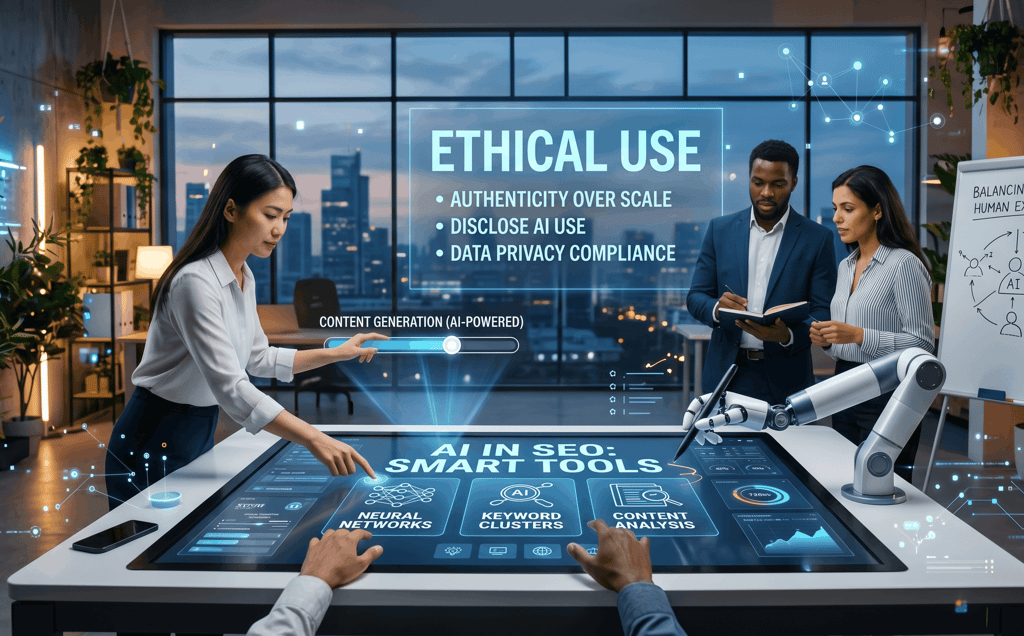
AI in SEO: Smart Tools and Ethical Use
A few years ago, if someone had told me that artificial intelligence would become a regular part of digital marketing, content creation, and SEO, I would have been curious but cautious.
Today, AI is everywhere.
It's helping marketers research keywords, generate content ideas, analyze data, optimize websites, and automate repetitive tasks. Whether you're a local business owner in Udupi, a hotel marketer in Mangalore, or an entrepreneur running an online store from Bengaluru, chances are you've already interacted with AI-powered tools without even realizing it.
But with all this excitement comes an important question:
Just because AI can do something, should it?
As someone who has spent more than 12 years in internet marketing and hotel marketing, I've learned that technology is most valuable when it supports human creativity rather than replacing it.
In this article, I'll share my thoughts on AI in SEO, the tools that genuinely help, the risks people should understand, and how to use artificial intelligence ethically while building sustainable search visibility.
If you're wondering how to balance innovation with authenticity, this guide is for you.
[Image Suggestion: Digital marketer working with AI-powered SEO dashboards and analytics tools]
Understanding the Growing Role of AI in SEO
Artificial intelligence is not new to search engines.
In fact, Google has been using AI and machine learning in its search systems for years.
Google's search ranking systems use advanced machine learning technologies to better understand user intent and deliver relevant search results.
What has changed recently is accessibility.
Today, small businesses and individual marketers can access powerful AI tools that were once available only to large organizations.
What AI Can Help With in SEO
AI SEO tools can assist with:
Keyword research
Topic discovery
Content planning
Content optimization
Competitor analysis
Technical SEO audits
Search intent analysis
Internal linking suggestions
Data analysis
These capabilities can save significant time.
However, AI works best as an assistant—not a replacement for expertise.
Why Human Experience Still Matters
AI can summarize information.
AI can organize ideas.
AI can analyze patterns.
But AI cannot replace genuine human experience.
For example, when I write about hotel marketing, tourism trends, or business growth in Coastal Karnataka, I'm drawing from years of real-world observations, client interactions, and local understanding.
That human perspective creates trust.
And trust remains one of the most valuable assets in digital marketing.
The Best Ways to Use AI in SEO
When used correctly, AI can become a powerful productivity partner.
1. Keyword Research and Topic Discovery
One of my favorite uses of AI is brainstorming content opportunities.
AI can help identify:
Long-tail keywords
Related search queries
Frequently asked questions
Topic clusters
Content gaps
Instead of staring at a blank screen, marketers can quickly build a content roadmap.
2. Content Brief Creation
AI tools can help organize:
Article outlines
Subtopics
User intent
Competitor insights
This reduces planning time while helping writers stay focused.
3. Technical SEO Analysis
Many modern SEO platforms use AI to detect:
Crawl issues
Broken links
Duplicate content
Site performance problems
For larger websites, this can save hours of manual work.
4. Data Interpretation
SEO generates enormous amounts of data.
AI can help identify:
Ranking trends
Traffic patterns
User behavior insights
Emerging opportunities
This allows marketers to spend more time making decisions rather than collecting information.
[Image Suggestion: AI-powered SEO workflow showing research, analysis, optimization, and reporting]
The Ethical Challenges of AI in SEO
While AI offers exciting possibilities, it also raises important ethical concerns.
This is where I believe marketers need to slow down and think carefully.
The Risk of Mass-Produced Content
One of the biggest problems I see today is the flood of generic AI-generated content.
Many websites publish hundreds of articles without:
Original insights
Real expertise
Personal experience
Fact-checking
The result?
Content that sounds polished but says very little.
Readers can often sense this immediately.
Misinformation and Hallucinations
AI systems sometimes generate incorrect information.
These errors are often called "hallucinations."
This becomes especially dangerous in topics involving:
Health
Finance
Legal matters
Safety advice
Every factual claim should be verified before publication.
As marketers, we have a responsibility to ensure accuracy.
Authenticity Matters More Than Ever
Ironically, as AI-generated content becomes more common, authentic human content becomes more valuable.
People want:
Real stories
Honest experiences
Practical lessons
Genuine expertise
That's something algorithms alone cannot create.
Google's View on AI-Generated Content
One of the most common questions I receive is:
"Does Google penalize AI content?"
The answer is more nuanced.
Google has stated that its focus is on content quality rather than how content is produced.
According to Google's guidance, the key factor is whether content is helpful, reliable, and created for people.
Google's E-E-A-T Principles
Google encourages content that demonstrates:
Experience
Expertise
Authoritativeness
Trustworthiness
This framework is often called E-E-A-T.
What This Means for Marketers
Instead of asking:
"Can AI write this article?"
Ask:
"Does this article genuinely help someone?"
That's a much better SEO question.
When AI supports knowledgeable humans, quality improves.
When AI replaces expertise entirely, quality often declines.
A Practical Framework for Ethical AI SEO
Over time, I've developed a simple approach for using AI responsibly.
Step 1: Let Humans Lead Strategy
AI can assist.
Humans should decide:
Business goals
Audience needs
Brand voice
Content priorities
Strategy should never be outsourced completely.
Step 2: Use AI for Efficiency
Good uses include:
Research support
Draft outlines
Content organization
Data analysis
These tasks improve productivity without sacrificing authenticity.
Step 3: Add Personal Experience
This is where true value emerges.
Ask yourself:
What have I personally learned?
What mistakes have I seen?
What insights can only experience provide?
These additions transform generic content into meaningful content.
Step 4: Verify Every Fact
Always fact-check:
Statistics
Research findings
Dates
Industry claims
Never assume AI-generated information is automatically accurate.
Step 5: Prioritize Reader Value
Every piece of content should answer:
"How does this help the reader?"
If the answer is unclear, rethink the content.
[Image Suggestion: Human and AI collaborating on content strategy with quality control checklist]
What Businesses in Coastal Karnataka Can Learn from AI
Living and working in Coastal Karnataka has influenced how I think about technology.
Our region balances tradition and progress beautifully.
You'll find modern digital businesses operating alongside centuries-old cultural practices.
Families still gather for meals.
Farmers still watch weather patterns closely.
Communities remain deeply connected to nature.
I believe AI should follow a similar philosophy.
Technology Should Support Human Values
AI should help us:
Save time
Reduce repetitive work
Improve efficiency
Increase accessibility
But it shouldn't remove:
Creativity
Empathy
Critical thinking
Human connection
Sustainability Applies to Digital Marketing Too
In nature, shortcuts often create long-term problems.
The same is true online.
Websites built entirely on automated content may see short-term gains but often struggle to build trust.
Sustainable SEO comes from:
Consistency
Quality
Credibility
User focus
These principles remain timeless.
The Future of AI in SEO
AI will undoubtedly continue transforming search marketing.
We are already seeing:
AI-generated search summaries
Conversational search experiences
Smarter search intent analysis
Advanced personalization
This creates both opportunities and challenges.
Skills That Will Become More Valuable
As AI becomes more capable, human skills become even more important.
Future-ready marketers should strengthen:
Strategic thinking
Storytelling
Brand building
Critical analysis
Industry expertise
Relationship building
These qualities are difficult to automate.
The Winning Formula
I believe the future belongs to marketers who combine:
Human wisdom + AI efficiency + ethical responsibility
This combination creates content that serves both users and businesses.
And ultimately, that's what good SEO has always been about.
[Image Suggestion: Future-focused SEO professional balancing technology, ethics, and human creativity]
Conclusion
AI in SEO is neither a miracle solution nor a threat to be feared.
It is a tool.
Like any tool, its value depends on how we use it.
The most successful marketers will not be those who automate everything. They will be those who use AI thoughtfully while preserving authenticity, expertise, and trust.
Over the years, I've learned that sustainable success—whether in business, marketing, or life—comes from balance.
Just as we respect nature while embracing progress, we should embrace AI while staying grounded in human values.
Use AI to save time.
Use AI to learn faster.
Use AI to work smarter.
But never forget that genuine relationships, lived experience, and honest communication remain at the heart of effective marketing.
That's true today, and I believe it will remain true for many years to come.
FAQs
1. What is AI in SEO?
AI in SEO refers to using artificial intelligence tools to assist with keyword research, content planning, technical audits, data analysis, and optimization tasks.
2. Is AI-generated content bad for SEO?
Not necessarily. Google focuses on content quality and usefulness rather than the method used to create content.
3. Can AI replace SEO professionals?
No. AI can automate tasks and provide insights, but strategy, creativity, expertise, and decision-making still require human involvement.
4. What are the best uses of AI in SEO?
Common uses include keyword research, content ideation, technical audits, competitor analysis, and performance reporting.
5. What are the risks of using AI for content creation?
Potential risks include factual inaccuracies, generic content, lack of originality, and reduced trust if human oversight is absent.
6. How can businesses use AI ethically?
Businesses should verify facts, prioritize user value, disclose sensitive AI use when appropriate, and ensure human review of important content.
7. Does Google penalize AI content?
Google evaluates content quality rather than creation method. Helpful, reliable, people-first content aligns with Google's guidance.
8. What is the future of AI in SEO?
AI will likely become more integrated into search and marketing workflows, making human expertise, creativity, and trustworthiness even more important.
.
Click Here to know about Audience Building Through Thoughtful Posting
Anudeep Hegde
Seasoned Internet Marketing Specialist and Hotel Marketing Expert with over 14+ years of experience helping brands grow and succeed online.
Get in touch
connect@anudeephegde.com
Bangalore & Kundapura, India
© 2026. All rights reserved. @Trip Nirvigna Marketing
+91 9449507266, +91 9731258717