AI Workflow Automation for Indian Hospitals: 7 High‑Impact Use Cases for 50–150 Bed Setups
AI workflow automation can quietly fix many of the things that frustrate doctors, nurses and patients in a 50–150 bed Indian hospital—without asking anyone to “learn coding” or buy robots.
Anudeep Hegde
3/17/20265 min read
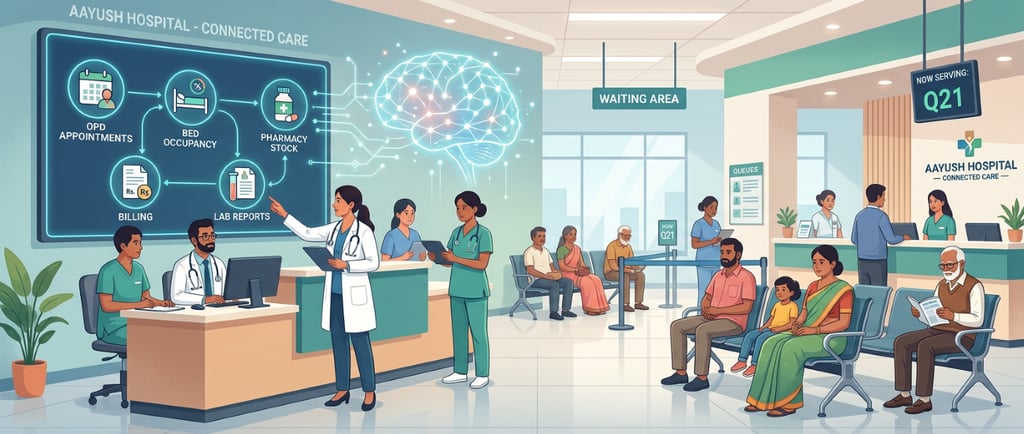
AI Workflow Automation for Indian Hospitals: 7 High‑Impact Use Cases for 50–150 Bed Setups
Most 50–150 bed hospitals in India run on a mix of HIS software, Excel, WhatsApp groups and phone calls. The result is:
Long waiting times in OPD
Last‑minute rush for beds and OTs
Confusion around test reports and discharge
Pharmacy stock‑outs or over‑stock
Staff burnout due to constant “fire‑fighting”
AI workflow automation simply means:
Using your existing hospital data (registrations, OPD numbers, bed status, pharmacy, billing) to predict, route and automate routine tasks.pib+4
Done right, it works in the background and shows up as:
Fewer queues
Fewer angry patients
More time for real clinical work
Below are 7 high‑impact use cases that a typical 50–150 bed Indian hospital can actually implement.
1. Smarter OPD appointments and no‑show reduction
The problem
OPD days are either overcrowded or half‑empty.
Some doctors see 60+ patients, while others sit idle.
Follow‑up patients forget appointments; new patients wait for hours.
How AI workflows help
An AI scheduling engine looks at your past OPD data (day of week, doctor, speciality, no‑show rates) and:
Suggests ideal slot lengths and daily limits per doctor.
Predicts days/times with high no‑show risk.
Automatically sends WhatsApp/SMS reminders and allows patients to confirm or reschedule.logicon+3
Example impact
Hospitals using AI‑driven scheduling have cut no‑shows by 20–30% and reduced average waiting times by similar margins.pmc.ncbi.nlm.nih+4
For a 50‑bed hospital with 5–8 consultants, this can translate into dozens of extra kept appointments per week without adding new doctors.
For administrators, this means more predictable OPD flow and less chaos at the front desk.
2. Emergency and triage routing
The problem
Casualty / emergency often gets overloaded suddenly.
It’s hard to know which incoming patients are truly urgent.
Junior staff have to make quick triage decisions with incomplete information.
How AI workflows help
AI‑assisted triage tools can:
Take basic inputs (age, symptoms typed or selected, vitals, maybe a quick photo or ECG snapshot) and suggest risk levels.
Prioritise patients into critical, urgent, routine queues.
Alert on‑call specialists automatically for “red flag” cases.kernshell+4
These systems don’t replace doctors; they help standardise triage so that the sickest patients are seen first.
Example impact
Studies and pilots show AI‑supported triage can reduce time to first clinical contact for high‑risk patients in busy emergency settings.eicta.iitk+1
For medium hospitals, this can be implemented as a simple app or kiosk at casualty with nurse oversight, not an expensive gadget.
3. Bed management and discharge planning
The problem
Bed status is often tracked on whiteboards, Excel or phone calls.
Planned admissions and discharges clash, leading to “no bed” situations.
Discharge summaries and final billing get delayed, keeping patients waiting in corridors.
How AI workflows help
Using admission, surgery and length‑of‑stay data, AI can:
Predict expected discharge dates for inpatients.
Show a live bed dashboard with likely free beds in the next 24–72 hours.
Flag cases where discharge is likely to be delayed (e.g., pending reports, TPA approval, consultant notes).ey+4
Automation can also:
Trigger discharge workflows early in the day:
Notify doctors to complete notes.
Remind pharmacy, billing and nursing to prepare documents/medications.
Example impact
AI‑based patient‑flow tools have helped hospitals reduce bed blocking and OT cancellations, and better predict length of stay.intuitionlabs+3
Even a 5–10% improvement in bed turnover in a 100‑bed hospital directly boosts both patient throughput and revenue.
4. Pharmacy and consumables inventory
The problem
Frequent stock‑outs of fast‑moving drugs and consumables.
Expiry losses due to over‑ordering slow‑moving items.
Pharmacy staff spend hours on manual stock checks and purchase planning.
How AI workflows help
An AI inventory module uses past consumption data, seasonal trends and supplier lead times to:
Forecast demand for key drugs and consumables.
Suggest optimal reorder levels and quantities.
Flag items at expiry‑risk.bizdata360+4
It can also:
Generate purchase suggestions for approval, instead of manual Excel sheets.
Example impact
AI‑driven inventory has helped hospitals and pharmacies reduce stock‑outs and cut expiry losses by 10–20%, while lowering working capital tied up in inventory.logicon+3
For a medium Indian hospital with a sizeable pharmacy and OT store, this is real money saved and fewer angry attendants hunting for medicines outside.
5. Billing, insurance and claims automation
The problem
TPA/insurance claims get stuck due to documentation errors or missing information.
Billing staff repeatedly chase doctors for clarifications.
Patients and families have to wait hours at discharge for final approval.
How AI workflows help
AI and automation can:
Read and check discharge summaries, prescriptions and investigation lists against insurance rules and packages.
Flag missing information before the claim goes to TPA.
Auto‑fill standard fields in claim forms from the HIS.
Track TPA status and send alerts when responses come in.intuz+3
Example impact
Hospitals using AI‑assisted billing and claims processing report fewer rejections and faster approvals, reducing discharge delays.kernshell+3
This also frees billing staff time to focus on exceptions instead of repetitive data entry.
6. Documentation and note‑taking for doctors
The problem
Doctors spend significant time on notes, discharge summaries, consent forms and order entry.
In many Indian hospitals, this is still partly handwritten, then typed by someone else.
Documentation delays slow down care and discharge.
How AI workflows help
AI assistants can:
Convert doctor’s voice notes into structured clinical notes and discharge summaries.
Suggest standard templates based on speciality and diagnosis.
Pre‑fill routine parts (demographics, vitals, meds) from the HIS.aimultiple+3
Example impact
Apollo Hospitals in India reportedly allocated about 3.5% of their digital budget to AI tools that automate documentation and scheduling, with an aim to free 2–3 hours per clinician per day.[intuitionlabs]
Global examples show administrative time per patient can drop from 15 minutes to 1–5 minutes when AI assists with chart management and documentation.pmc.ncbi.nlm.nih+1
For a mid‑sized Indian hospital, even freeing 30–60 minutes per doctor per day means more patient time or reduced burnout.
7. Management dashboards and quality monitoring
The problem
Hospital owners and administrators often get:
Fragmented or delayed reports (monthly Excel, manual MIS).
Limited visibility into real‑time bottlenecks (OPD load, bed occupancy, OT utilisation, lab turnaround times).
How AI workflows help
AI‑powered dashboards can pull data automatically from HIS/LIS/RIS and:
Show live metrics: OPD queue length, bed occupancy, average waiting time, lab pending reports.
Highlight patterns and outliers:
Which departments face the longest waits?
Which procedures have highest cancellation or delay?
Even suggest “what to look at today” for admins, instead of making them dig through reports.ocacademy+4
Example impact
Indian hospitals that deployed integrated platforms with automated dashboards report faster decision‑making and fewer manual reporting errors.navighealth+2
For a 50–150 bed setup, a simple daily view of 5–10 core metrics can dramatically improve control without adding more managers.
What needs to be in place before you start
AI workflow automation is powerful—but it’s not magic. Medium hospitals need a few basics first:
Digitised data: A reasonably used HIS (not perfect, but actively used for registrations, billing, pharmacy, etc.).pib+3
Clean identifiers: MRN/URN for each patient, clear mapping across departments.
Basic IT hygiene: Regular data backup, secure access, basic training for staff.
One or two internal champions: Usually a doctor‑administrator plus an IT/operations person who will co‑own rollout.
You don’t need to start with all seven use cases. Pick one or two pain points—for example, OPD no‑shows + pharmacy stock‑outs—prove value there, then expand.
How a 50–150 bed hospital can start in 90 days
A simple, practical path:
30 days – Discover & prioritise
Map current workflows for OPD, beds, pharmacy, billing.
Identify top two bottlenecks (e.g., OPD wait times and pharmacy issues).
30–60 days – Pilot one AI workflow
Work with a vendor/partner to plug an AI module into your HIS (or even start with a separate tool + CSV/Excel export).
Run a small pilot for one department / one speciality.
60–90 days – Measure & decide
Track before/after metrics: waiting time, no‑shows, stock‑outs, discharge time, etc.
If impact is clear, expand to more departments and workflows.
Final thought
For most medium‑scale Indian hospitals, AI workflow automation is less about futuristic machines and more about making the hospital run like a well‑coordinated team instead of a daily fire‑fight.bizdata360+5
If you already have software and data, you are closer than you think. The next step is to decide which everyday frustration you want to fix first—and then let AI quietly handle the repetitive work in the background so your people can focus on what only humans can do: care.
Anudeep Hegde
Seasoned Internet Marketing Specialist and Hotel Marketing Expert with over 12+ years of experience helping brands grow and succeed online.
Get in touch
connect@anudeephegde.com
+91 9449507266, +91 9731258717
© 2026. All rights reserved. @Trip Nirvigna Marketing