How to Build a Scalable Business from Scratch
Learn how to build a scalable business from scratch with practical strategies, real-life insights, and proven growth principles from a digital marketing expert.
Anudeep hegde
7/3/20263 min read
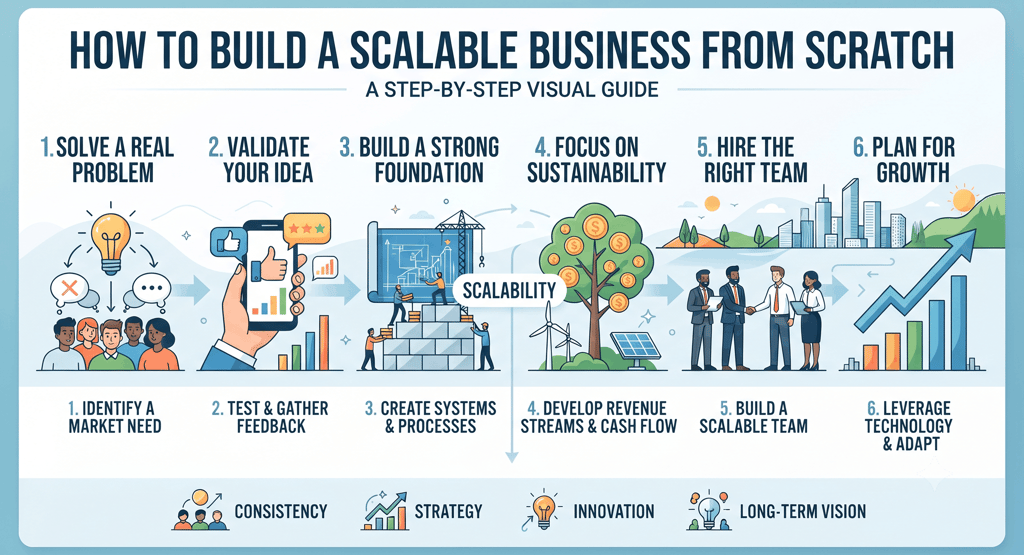
Build a Scalable Business from Scratch
Every successful business starts with a simple idea. The difference between businesses that stay small and those that grow isn't always money, luck, or even talent. More often, it's about building a strong foundation that can handle growth without breaking.
Over the last 12 years as an Internet Marketing Specialist, I've had the privilege of working with businesses across India, especially hotels, local entrepreneurs, startups, and family-owned businesses in Coastal Karnataka. One thing I've noticed is that many business owners focus on getting more customers but rarely prepare their business for growth.
Growing up in Byndoor, I saw small grocery stores, fisheries, hotels, and family businesses thrive because they understood consistency, relationships, and quality. They didn't call it "scalability," but they unknowingly followed many of the same principles modern businesses use today.
Building a scalable business from scratch isn't about becoming the next unicorn startup. It's about creating systems, processes, and a mindset that allow your business to grow steadily without demanding more of your personal time every single day.
According to the World Bank, small and medium-sized enterprises (SMEs) account for the majority of businesses worldwide and play a vital role in employment and economic growth. Businesses that invest in systems, technology, and long-term planning are generally better positioned to scale sustainably.
In this guide, I'll share practical lessons from my own journey, experiences working with clients, and strategies that can help you build a business capable of growing year after year.
[Image Suggestion: Entrepreneur planning business growth on a laptop with notebook and coffee.]
Why Most Businesses Struggle to Scale
Many businesses don't fail because of poor products.
They struggle because the owner becomes the business.
If every customer call depends on you...
If every marketing decision requires your approval...
If every payment, invoice, and client meeting needs your attention...
Your business isn't scalable.
I've seen talented entrepreneurs across Karnataka work 14-hour days. Their businesses appear successful from the outside, but they're trapped inside operations.
Instead of building a company, they've created a demanding job for themselves.
Common Reasons Businesses Stop Growing
No documented processes
Inconsistent marketing
Depending on referrals alone
Lack of financial planning
Poor delegation
No measurable business goals
Fear of investing in technology
Trying to serve everyone
Scaling begins when you stop thinking like a worker and start thinking like a business owner.
Start With Solving One Real Problem
One mistake I often see is entrepreneurs trying to create products first and look for customers later.
Successful businesses usually do the opposite.
They identify a real problem and create the simplest possible solution.
When I started working in digital marketing, I wasn't trying to become an SEO consultant.
I simply noticed that many businesses had beautiful websites that nobody could find on Google.
That problem became my opportunity.
Ask Yourself These Questions
What problem am I solving?
Who experiences this problem every day?
Why hasn't someone solved it properly?
Can I solve it better, faster, or more affordably?
The clearer your answers, the easier marketing becomes.
People don't buy products.
They buy solutions.
Validate Before You Invest
Before spending lakhs on branding or software, validate your idea.
Simple ways include:
Talking to potential customers
Running small digital campaigns
Creating a landing page
Collecting feedback
Offering pilot services
Conducting surveys
Many successful startups begin with learning—not launching.
[Image Suggestion: Founder discussing business ideas with customers in a local café.]
Build Systems, Not Dependence
One lesson that completely changed my perspective was understanding the power of systems.
Imagine two restaurants.
Restaurant A depends entirely on its owner.
Restaurant B has documented recipes, staff training, inventory systems, marketing calendars, and customer feedback processes.
Which business is easier to expand?
Obviously, Restaurant B.
The same principle applies whether you're running an SEO agency, hotel, retail shop, or software company.
Every Scalable Business Needs Systems
Create systems for:
Sales
Lead generation
Follow-ups
Proposal creation
Customer onboarding
Marketing
Content calendar
Social media posting
Email campaigns
SEO strategy
Operations
Daily workflows
Customer support
Documentation
Reporting
Finance
Expense tracking
Profit analysis
Invoicing
Cash flow management
When processes are documented, anyone on your team can learn them.
Your business becomes less dependent on one individual.
That's real scalability.
Use Technology Wisely
Technology isn't about replacing people.
It's about removing repetitive work.
Today, businesses can automate:
Appointment booking
Email marketing
Customer reminders
Invoice generation
Analytics reporting
CRM management
Automation allows business owners to spend more time on strategy instead of routine tasks.
Create a Brand People Remember
Many businesses compete only on price.
That's a dangerous game.
There will always be someone cheaper.
Instead, build a brand that customers trust.
Living in Coastal Karnataka has taught me something valuable.
People return to the same hotel, restaurant, mechanic, or grocery store because of trust—not discounts.
The same applies online.
Your brand is what people remember after they leave your website.
Build Trust Through Consistency
Consistency matters more than perfection.
Maintain consistency in your:
Website
Logo
Brand colours
Communication
Customer service
Social media
Content quality
When customers repeatedly see the same values, tone, and professionalism, trust grows naturally.
Share Your Story
People connect with people.
Don't be afraid to share:
Why you started
Challenges you've faced
Lessons you've learned
Behind-the-scenes moments
Customer success stories
Some of my most meaningful conversations with clients didn't begin with SEO.
They began with shared experiences, family values, and understanding each other's business journey.
Stories build emotional connections.
And emotional connections build lasting brands.
.
Click here to know about How to Hire the Right Marketing Help
Anudeep Hegde
Seasoned Internet Marketing Specialist and Hotel Marketing Expert with over 12+ years of experience helping brands grow and succeed online.
Get in touch
connect@anudeephegde.com
+91 9449507266, +91 9731258717
© 2026. All rights reserved. @Trip Nirvigna Marketing