Goal Review Frameworks for Quarterly Planning
Discover practical goal review frameworks for quarterly planning. Learn how to stay focused, track progress, and achieve meaningful results consistently.
MARKETING
Anudeep Hegde
6/25/20266 min read
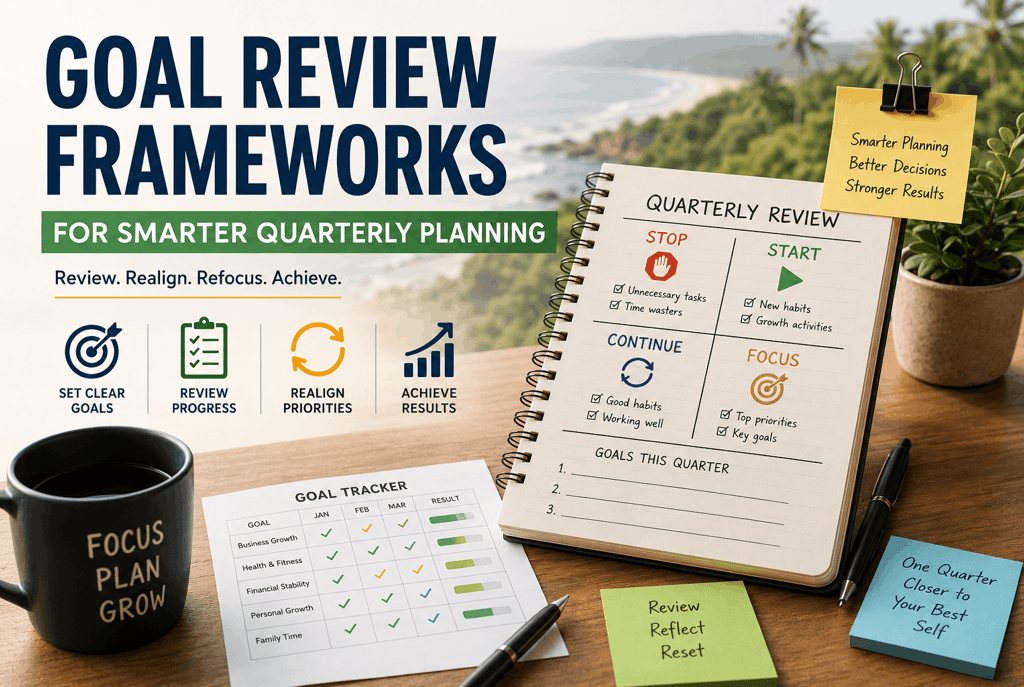
Goal Review Frameworks for Smarter Quarterly Planning
Every January, many of us start with a notebook full of goals, excitement, and motivation. We promise ourselves that this will be the year we get fitter, grow our business, spend more time with family, learn new skills, or finally complete those projects we've been postponing.
But by the time March or April arrives, reality often looks different.
Work gets busy. Family responsibilities increase. Unexpected events demand attention. The goals that once felt exciting slowly move to the background.
I've seen this happen countless times—not just in businesses I consult for, but also in my own life.
Over the last 12+ years working in digital marketing and hotel marketing, I've learned that success rarely comes from setting better goals. It comes from reviewing them consistently.
That's where effective goal review frameworks for quarterly planning become incredibly valuable.
Rather than waiting until the end of the year to evaluate progress, quarterly reviews create a rhythm of reflection, adjustment, and improvement. They help us stay aligned with what truly matters while remaining flexible enough to adapt to changing circumstances.
In this article, I'll share practical goal review frameworks, lessons from experience, and actionable steps you can start using immediately.
Why Quarterly Planning Works Better Than Annual Planning
Many people create annual goals but never establish a system to monitor progress.
A year is simply too long.
Think about life in Coastal Karnataka. The rhythm of our year naturally changes with seasons. Summer brings heat and travel. Monsoon changes routines completely. Festivals, family events, school schedules, and business cycles all influence our priorities.
Planning in smaller blocks allows us to adapt.
Research published by the American Psychological Association has consistently shown that specific goals combined with regular feedback improve performance significantly compared to vague intentions.
Quarterly planning offers three major advantages:
It creates manageable time horizons.
It encourages regular reflection.
It allows quick course correction.
Instead of asking:
"Did I achieve my annual goal?"
You begin asking:
"Am I moving in the right direction this quarter?"
That shift changes everything.
Key takeaway: Quarterly reviews turn goals into ongoing conversations rather than annual judgments.
[Image Suggestion: Person reviewing goals in a notebook while sitting near a coastal landscape with a cup of coffee.]
The Foundation: Separate Goals Into Life Categories
One mistake I made earlier in my career was focusing almost entirely on business growth.
Revenue increased.
Clients increased.
Workload increased.
But balance decreased.
Over time, I realised meaningful planning requires looking beyond professional achievements.
Before reviewing any goal, I recommend organizing them into categories.
Personal Health
Examples:
Daily walking
Strength training
Better sleep
Weight management
Stress reduction
Family and Relationships
Examples:
Weekly family time
Parent care
Date nights
Meaningful conversations
Career and Business
Examples:
Revenue targets
Skill development
Marketing growth
Team building
Financial Goals
Examples:
Emergency fund
Investments
Debt reduction
Savings targets
Personal Growth
Examples:
Reading
Learning new skills
Spiritual practices
Volunteering
Community and Sustainability
Living in Karnataka constantly reminds me how interconnected our lives are with nature.
Goals here may include:
Reducing waste
Supporting local businesses
Tree planting
Sustainable living habits
When goals are balanced across categories, quarterly reviews become more meaningful.
Framework #1: The Stop, Start, Continue Review
This is one of the simplest and most effective frameworks I've used.
Every quarter, ask three questions.
What Should I Stop?
Identify activities that are not producing results.
Examples:
Unnecessary meetings
Time-consuming habits
Projects with low impact
Excessive social media usage
What Should I Start?
Identify new actions that can create progress.
Examples:
Morning walks
Weekly planning sessions
Learning AI tools
Monthly financial reviews
What Should I Continue?
Recognize habits already working well.
Examples:
Consistent exercise
Client relationship building
Reading habits
Family dinners
Why It Works
This framework prevents quarterly reviews from becoming complicated.
It focuses on behavior instead of just outcomes.
Often, improving daily habits naturally improves results.
Review QuestionPurposeStopRemove distractionsStartCreate growthContinueReinforce success
[Image Suggestion: Simple quarterly review worksheet with Stop, Start, Continue columns.]
Framework #2: The Traffic Light Method
This framework works particularly well for busy professionals and entrepreneurs.
Each goal receives a status.
Green
On track.
Examples:
70–100% progress
Consistent momentum
No major concerns
Yellow
Needs attention.
Examples:
Delayed progress
Resource challenges
Reduced focus
Red
Off track.
Examples:
No measurable progress
Significant obstacles
Goal no longer relevant
The Real Value
Many people feel guilty when they see red goals.
I look at them differently.
A red goal is information.
It tells you something needs adjustment.
Sometimes the goal was unrealistic.
Sometimes priorities changed.
Sometimes life happened.
The purpose isn't perfection.
The purpose is awareness.
Framework #3: The 3 Wins, 3 Lessons Review
This framework adds reflection and gratitude to quarterly planning.
At the end of every quarter, write:
Three Wins
Examples:
Improved website traffic
Better fitness consistency
More family time
Three Lessons
Examples:
Taking on too many projects creates stress.
Sleep affects productivity more than expected.
Delegation improves business growth.
Why This Matters
Many high achievers only notice what remains unfinished.
They rarely acknowledge progress.
Over time, that mindset creates burnout.
Celebrating wins builds motivation.
Learning lessons builds wisdom.
Both are equally important.
In my experience, sustainable growth comes from balancing ambition with appreciation.
[Image Suggestion: Journal page showing wins, lessons, and next-quarter priorities.]
Framework #4: The SMART Goal Review System
Most people know SMART goals.
However, very few actually review goals using the SMART framework every quarter.
SMART stands for:
Specific
Is the goal clearly defined?
Measurable
Can progress be tracked objectively?
Achievable
Is it realistic given current circumstances?
Relevant
Does it still matter?
Time-Bound
Is the timeline still appropriate?
Example
Instead of:
"Improve fitness."
Review:
"Walk 8,000 steps daily for 80% of the quarter."
This creates clarity.
Clarity improves execution.
During quarterly reviews, revisit each SMART element and adjust where necessary.
Framework #5: The Energy and Impact Matrix
One framework I increasingly rely on evaluates goals through two lenses:
Impact
How much value will this goal create?
Energy
How much effort will it require?
Plot goals into four categories.
High Impact, Low Energy
Do these first.
Examples:
Automating repetitive tasks
Simple health improvements
Better scheduling systems
High Impact, High Energy
Plan carefully.
Examples:
Business expansion
Major certifications
Property investments
Low Impact, Low Energy
Complete only if necessary.
Low Impact, High Energy
Question whether these goals deserve attention.
This framework prevents us from staying busy while making little progress.
One lesson I've learned from working with business owners is that productivity and effectiveness are not the same thing.
Being busy isn't the goal.
Creating meaningful outcomes is.
[Image Suggestion: Four-quadrant impact versus energy matrix for goal prioritization.]
How to Conduct a Quarterly Goal Review in 60 Minutes
You don't need an entire weekend.
A focused one-hour session can be enough.
Step 1: Review Previous Quarter (10 Minutes)
Ask:
What worked?
What didn't?
What surprised me?
Step 2: Assess Current Goals (15 Minutes)
Use:
Traffic Light Method
SMART Review
Stop, Start, Continue
Step 3: Identify Top Priorities (15 Minutes)
Choose:
Three major goals
Three supporting habits
Avoid setting ten priorities.
Everything cannot be a priority.
Step 4: Remove Distractions (10 Minutes)
Identify:
Low-value commitments
Time drains
Unnecessary projects
Step 5: Create Action Plan (10 Minutes)
Schedule:
Weekly reviews
Key milestones
Accountability checkpoints
The simpler the system, the more likely you'll follow it.
Common Quarterly Planning Mistakes to Avoid
Setting Too Many Goals
Focus creates progress.
Too many goals create confusion.
Ignoring Health
According to the World Health Organization, physical inactivity remains a significant global health concern linked to various chronic diseases.
Health goals should never be postponed indefinitely.
Measuring Only Outcomes
Track behaviors too.
For example:
Instead of only measuring revenue:
Track:
Sales calls
Content published
Client meetings
Never Adjusting Goals
Life changes.
Markets change.
Families change.
Goals should evolve when circumstances evolve.
Comparing Your Journey to Others
Social media often highlights achievements but hides struggles.
Review your progress against your own previous quarter—not someone else's highlight reel.
Bringing Quarterly Planning Into Everyday Life
The most successful goal review frameworks are not complicated.
They're consistent.
Living in Coastal Karnataka has taught me a valuable lesson.
Nature follows cycles.
The sea changes daily.
The monsoon arrives on its own schedule.
Farmers plan season by season.
Growth happens gradually.
Our goals work the same way.
Big achievements rarely appear overnight.
They emerge from small improvements reviewed consistently over time.
Quarterly planning gives us a chance to pause, reflect, and realign before small problems become major setbacks.
That's why I believe every individual, entrepreneur, student, and professional can benefit from adopting a structured review process.
Conclusion
The best goal review frameworks for quarterly planning aren't the ones with the most complicated spreadsheets or sophisticated software.
They're the frameworks you actually use.
Whether you choose the Stop-Start-Continue method, Traffic Light reviews, SMART assessments, or the Energy and Impact Matrix, the objective remains the same: create awareness, maintain focus, and make steady progress.
Personally, I've found that quarterly reviews help me stay grounded. They remind me that success isn't just about business growth or financial achievements. It's also about health, family, learning, community, and living intentionally.
As you prepare for your next quarter, remember this:
You don't need a perfect plan. You need a regular review process.
Small improvements, repeated consistently, often create extraordinary results over time.
FAQs
1. What is a goal review framework?
A goal review framework is a structured method used to evaluate progress, identify challenges, and adjust goals regularly to improve outcomes.
2. Why is quarterly planning better than annual planning?
Quarterly planning allows faster adjustments, better focus, and more consistent progress while adapting to changing circumstances.
3. How often should I review my goals?
A brief weekly review combined with a detailed quarterly review works well for most people.
4. What is the easiest goal review framework?
The Stop, Start, Continue framework is one of the simplest and most effective methods for beginners.
5. Can businesses use these frameworks?
Absolutely. These frameworks are widely used in business planning, performance reviews, marketing strategy, and team management.
6. What should I do if a goal is off track?
Identify the reason, adjust the approach if necessary, and decide whether the goal remains relevant.
7. How many goals should I focus on per quarter?
For most people, three to five major goals are sufficient to maintain focus and momentum.
8. What tools can help with quarterly planning?
Simple notebooks, spreadsheets, project management tools, and digital planners can all support effective quarterly reviews.
If this article resonated with you, I'd love to hear your thoughts. Feel free to share your own quarterly planning habits, lessons, or challenges. And if you're looking for help with digital marketing, hotel marketing strategy, SEO, or online business growth, explore my portfolio and connect with me through www.anudeephegde.com. Let's build meaningful growth—one quarter at a time.
.
Click Here To know about Why Indian Professionals Need Stronger Online Presence
Anudeep Hegde
Seasoned Internet Marketing Specialist and Hotel Marketing Expert with over 12+ years of experience helping brands grow and succeed online.
Get in touch
connect@anudeephegde.com
+91 9449507266, +91 9731258717
© 2026. All rights reserved. @Trip Nirvigna Marketing