Internal Linking Strategy That Works
Learn an internal linking strategy that works to improve SEO, user experience, and rankings with practical tips, real examples, and proven best practices.
Anudeep Hegde
7/6/20266 min read
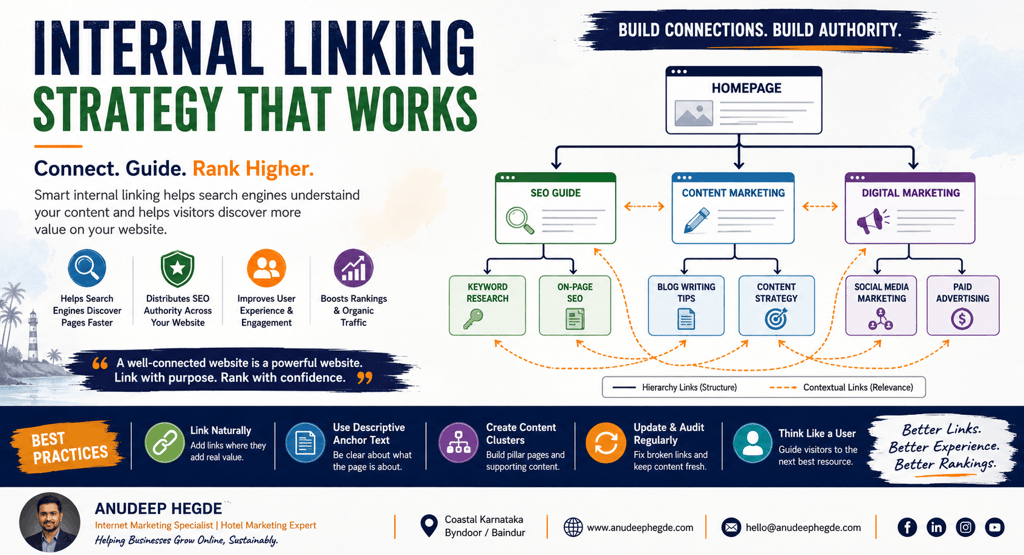
Internal Linking Strategy That Works
When people talk about SEO, most conversations revolve around backlinks, keywords, AI content, or technical audits. While these are important, I've noticed something interesting over the years working with hotels, local businesses, and growing websites—many websites struggle not because they lack content, but because their existing content isn't connected properly.
That's where an internal linking strategy that works can completely change the game.
Over the last 12+ years in internet marketing, I've worked on websites ranging from hospitality businesses to local brands. One common pattern I've seen is that even well-written articles often remain isolated. They receive a few visitors, rank for a while, and then slowly disappear because search engines and users don't clearly understand how they relate to the rest of the website.
Growing up in coastal Karnataka, I often think about how our villages are connected. A single road rarely serves the entire community. Instead, many smaller roads connect homes, schools, temples, beaches, farms, and marketplaces. Remove those connecting roads, and even beautiful places become difficult to reach.
A website works exactly the same way.
In this guide, I'll share the internal linking strategies I personally recommend, why they matter, common mistakes to avoid, and practical ways you can improve your website without creating a single new article.
Why Internal Linking Matters More Than Most People Think
Internal links are simply hyperlinks that connect one page on your website to another page on the same domain.
They help in three major ways:
Help search engines discover pages faster.
Distribute SEO authority across your website.
Guide visitors toward more useful information.
According to Google Search Central, internal links help Google understand the relationship between pages and identify which pages are more important within your website.
Unlike backlinks, internal links are completely under your control.
That makes them one of the easiest SEO improvements you can implement today.
Think of internal links as signboards inside a large shopping mall. Without signs, visitors wander around. With proper directions, they quickly find what they need.
Image Suggestion: Website architecture showing homepage connecting to categories and blog posts.
Build Your Website Like a Helpful Guide, Not a Maze
One mistake I frequently see is writing articles whenever inspiration strikes without thinking about how each article fits into the bigger picture.
A good website has structure.
Instead of random pages, organize your content into related topics.
Example Content Cluster
Suppose you run a hotel marketing website.
Your main pillar page could be:
Hotel Digital Marketing Guide
Supporting articles could include:
SEO for Hotels
Google Business Profile Optimization
Hotel Social Media Marketing
Online Reputation Management
Hotel Website Design
Booking Engine Optimization
Local SEO for Resorts
Every supporting article links back to the main guide, while the guide links to every supporting article.
Google calls this creating a logical site hierarchy.
This approach helps search engines understand topical expertise.
It also keeps visitors engaged for longer.
Use Contextual Links That Feel Natural
One of the biggest mistakes is stuffing "Related Articles" everywhere while ignoring contextual links inside the content itself.
Contextual links are far more valuable.
For example, instead of writing:
Read another blog here.
Write:
Before improving your rankings, it's equally important to understand technical SEO fundamentals because even great content struggles if search engines cannot crawl your website efficiently.
Notice how the link naturally fits the sentence.
That's exactly what readers appreciate.
Best Practices
Link naturally within sentences.
Use descriptive anchor text.
Link only when it genuinely adds value.
Avoid forcing keywords into every link.
Think about what readers would want next.
Google recommends using descriptive anchor text because it helps users and search engines understand what they're clicking.
Create Pillar Pages That Become SEO Assets
If I had to choose one strategy that consistently works for long-term SEO, this would be it.
Instead of publishing dozens of disconnected articles, create comprehensive pillar pages around major topics.
These pages should answer almost every beginner question before directing readers toward detailed supporting articles.
Example Structure
Pillar Page
Complete Guide to Hotel Marketing
↓
Supporting Articles
SEO Strategy
Paid Advertising
Email Marketing
Social Media
Website Speed
Online Reviews
Conversion Optimization
This creates a clear topical relationship.
It also helps Google understand that your website has depth rather than isolated information.
According to Google Search Central documentation, creating helpful site architecture improves crawlability and user experience.
Image Suggestion: Visual content cluster diagram showing one pillar page linked to multiple related articles.
Smart Anchor Text Makes a Big Difference
Anchor text is the clickable text users see.
Poor examples include:
Click here
Learn more
Read this
Visit page
Better examples include:
Internal linking best practices
Hotel SEO checklist
Technical SEO audit guide
Local SEO strategies
Descriptive anchors provide context before users even click.
However, avoid repeating the exact same keyword dozens of times.
Natural language works best.
For example:
Instead of always linking with:
Internal Linking Strategy
Mix it naturally:
Internal linking guide
Website linking structure
Connecting related blog posts
SEO internal links
Building topic clusters
Variation feels natural while still maintaining relevance.
Don't Overdo Internal Links
Years ago, there was a belief that adding as many internal links as possible improved rankings.
That's no longer good practice.
Too many links create problems:
Readers become distracted.
Important links lose prominence.
Pages feel cluttered.
Search engines receive weaker relevance signals.
Instead, ask yourself:
Does this link genuinely help someone continue their learning journey?
If yes, keep it.
If not, remove it.
Quality beats quantity.
I often recommend prioritizing relevance over numbers.
A smaller website with thoughtful internal links often performs better than a larger website with hundreds of unnecessary connections.
Internal Linking Mistakes I See Again and Again
Here are some common issues during SEO audits.
1. Orphan Pages
These pages receive no internal links.
Search engines may discover them eventually, but users almost never do.
Every valuable page should have at least one relevant internal link.
2. Linking Everything to the Homepage
Many websites repeatedly link only to the homepage.
Instead, distribute authority across service pages, category pages, and educational content.
3. Ignoring Older Articles
New blogs often receive attention while older content slowly fades.
Whenever you publish a new article:
Update older related articles.
Add links to the new content.
Refresh outdated information.
This simple habit can significantly improve overall website health.
4. Generic Anchor Text
Avoid:
Here
This article
Read more
Instead, explain exactly what readers will find.
5. Broken Internal Links
Broken links frustrate visitors.
They also waste crawl resources.
Regularly check your website using SEO audit tools and fix broken URLs.
A Practical Internal Linking Workflow I Personally Follow
Whenever I publish a new article, I follow a simple checklist.
Step 1
Identify the primary topic.
Step 2
Search my own website for related content.
Step 3
Add 3–8 meaningful internal links where relevant.
Step 4
Return to older articles and add links pointing toward the new page.
Step 5
Review anchor text for clarity.
Step 6
Ensure the links genuinely help readers.
This process usually takes less than 20 minutes but provides long-term SEO benefits.
Just like maintaining a garden, small improvements made consistently produce healthier growth over time.
Living in coastal Karnataka has taught me that nature thrives because everything is connected. Rivers feed fields, trees protect the soil, and the sea influences our climate. Nothing exists in isolation.
The same principle applies to websites.
Every useful page should support another.
Every article should guide readers toward deeper understanding.
That's how trust grows.
Image Suggestion: Person reviewing website pages connected by arrows on a laptop.
Measuring Whether Your Internal Linking Strategy Is Working
A good strategy isn't based on guesswork.
Track these indicators regularly.
MetricWhy It MattersOrganic trafficBetter internal links often improve visibility.Average engagement timeReaders explore more pages.Pages per sessionVisitors continue their journey.Crawl reportsSearch engines discover pages efficiently.Rankings for target keywordsStronger topical authority can improve rankings over time.
You can monitor these using tools like Google Search Console and Google Analytics.
Remember, improvements usually happen gradually.
SEO rewards consistency more than shortcuts.
Conclusion
A strong internal linking strategy that works isn't about adding more links—it's about creating meaningful connections.
When every page supports another, visitors enjoy a smoother experience, search engines understand your website better, and your content works harder for you.
Throughout my journey helping businesses improve their online presence, I've learned that sustainable SEO success rarely comes from chasing quick wins. It comes from getting the fundamentals right, staying consistent, and always thinking about the person on the other side of the screen.
Whether you're managing a hotel website, a personal blog, an e-commerce store, or a local business website, take an hour this week to review your internal links. You might be surprised by how much hidden SEO potential is already sitting inside your existing content.
Just like the interconnected roads that keep our coastal Karnataka communities thriving, thoughtful internal links help every page contribute to the bigger journey.
Sometimes, the biggest improvements don't require creating more content—they simply require connecting what you already have.
FAQs
1. What is an internal linking strategy?
An internal linking strategy is the process of connecting related pages within the same website to improve SEO, user experience, and website navigation.
2. How many internal links should a blog post have?
There is no fixed number. Focus on relevance rather than quantity. For most in-depth articles, 3 to 8 meaningful internal links are often sufficient, depending on the topic and available content.
3. Do internal links improve Google rankings?
Internal links help search engines discover pages, understand content relationships, and distribute authority across your website. While they are only one ranking factor, they contribute to stronger overall SEO performance.
4. What is anchor text?
Anchor text is the clickable text used in a hyperlink. Descriptive anchor text helps users and search engines understand the destination page.
5. Should every page have internal links?
Yes. Important pages should both receive and provide relevant internal links whenever appropriate to avoid becoming orphan pages.
6. Can too many internal links hurt SEO?
Excessive or irrelevant internal links can dilute their value and create a poor user experience. Prioritize quality and relevance over volume.
7. What's the difference between internal links and backlinks?
Internal links connect pages within your own website, while backlinks come from external websites pointing to your content.
8. How often should I audit my internal links?
Review your internal linking structure every few months and whenever you publish significant new content. Regular audits help identify broken links, orphan pages, and fresh opportunities to strengthen your site's structure.
Anudeep Hegde
Seasoned Internet Marketing Specialist and Hotel Marketing Expert with over 14+ years of experience helping brands grow and succeed online.
Get in touch
connect@anudeephegde.com
Bangalore & Kundapura, India
© 2026. All rights reserved. @Trip Nirvigna Marketing
+91 9449507266, +91 9731258717