Mental Strength for Handling Client Rejections
Learn how to build mental strength for handling client rejections with practical advice, emotional resilience tips, and real business insights.
Anudeep Hegde
5/8/20266 min read
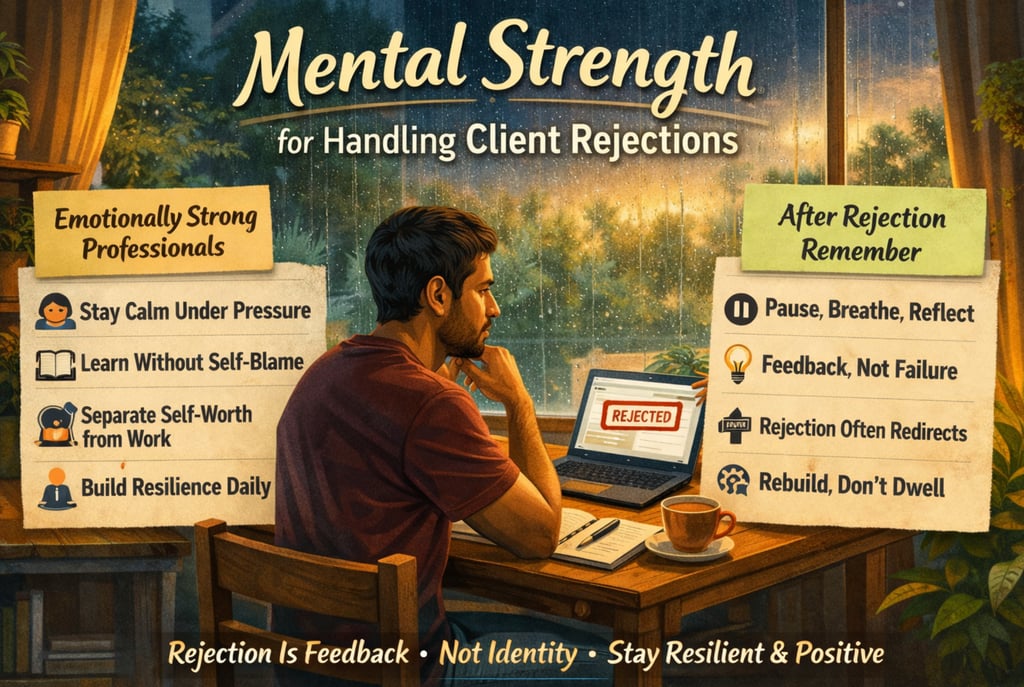
Mental Strength for Handling Client Rejections
One of the hardest lessons I learned in business was this:
No matter how sincere your work is, not every client will say yes.
In the early years of my digital marketing journey, I used to take every rejection personally. A rejected proposal could ruin my entire day. Sometimes even my confidence for a whole week. I would keep replaying conversations in my mind:
“Did I quote too high?”
“Was my presentation weak?”
“Maybe I’m not good enough.”
Over time, however, I realized something important:
Client rejection is not a sign of failure. It is part of growth.
Today, after working for more than 12 years in internet marketing and hotel marketing across Coastal Karnataka and beyond, I’ve understood that mental strength matters as much as professional skill.
Because in business — whether you are a freelancer, consultant, hotel marketer, entrepreneur, or creative professional — rejection is unavoidable.
The real question is:
Can you stay emotionally steady without losing your self-belief?
This article is for anyone who has ever:
Lost confidence after a rejected proposal
Felt emotionally drained by client silence
Struggled with self-doubt after losing projects
Wondered how successful professionals stay mentally strong
I want to share practical lessons, emotional insights, and grounded advice that genuinely helped me handle client rejections with more maturity, calmness, and resilience.
[Image Suggestion: A professional sitting quietly near a window during rain, reflecting calmly with a notebook and laptop]
Why Client Rejections Hurt So Much
Client rejection is not only about losing money.
It affects emotions deeply because work is personal.
When you spend hours:
Preparing strategies
Designing presentations
Writing proposals
Attending meetings
Understanding client problems
…you naturally become emotionally invested.
So when someone rejects your work, it can feel like they are rejecting you.
The Psychology Behind Rejection
According to research published by the American Psychological Association, social rejection activates similar brain regions associated with physical pain.
That explains why rejection can genuinely feel emotionally painful.
Many professionals silently experience:
Anxiety
Stress
Reduced motivation
Overthinking
Sleeplessness
Especially in freelance and service-based industries where uncertainty is constant.
In Coastal Karnataka, Reputation Matters Deeply
Growing up around places like Baindur, I noticed how strongly people value trust, relationships, and reputation.
In smaller towns and communities:
Word spreads quickly
Relationships matter deeply
Personal pride is connected to work
That emotional connection can make rejection feel even heavier.
But maturity teaches us an important truth:
Rejection is feedback, not identity.
The Biggest Mistake People Make After Rejection
The biggest mistake is emotional overreaction.
I’ve seen talented professionals:
Quit too early
Lose confidence
Become bitter
Undervalue themselves
Start doubting every decision
Rejection Creates Dangerous Self-Talk
After hearing “no,” many people internally say:
“I’m not talented enough.”
“Nobody values my work.”
“Others are better than me.”
But often, rejection has nothing to do with your capability.
Clients may reject proposals because of:
Budget limitations
Timing issues
Internal politics
Existing vendor relationships
Business uncertainty
Misaligned priorities
Sometimes clients simply are not ready.
One Rejection Does Not Define Your Future
Some of my best long-term clients initially ignored my emails.
Some projects I lost eventually returned months later.
Business is unpredictable.
That’s why emotional stability is critical.
[Image Suggestion: A rejected proposal paper beside a cup of tea and calm workspace]
Building Mental Strength for Handling Client Rejections
Mental strength is not about becoming emotionless.
It’s about learning how to recover faster without losing perspective.
Here are lessons that genuinely helped me over the years.
1. Separate Your Self-Worth from Your Work
This is the most important mindset shift.
Your proposal getting rejected does not mean:
You are unintelligent
Your experience has no value
Your future is ruined
It simply means:
“This particular opportunity did not work out.”
That’s all.
I Learned This the Hard Way
Early in my career, I attached my identity completely to work outcomes.
Good client response = happy mood.
Rejected proposal = emotional crash.
That’s emotionally exhausting.
Today, I try to remind myself:
“My value as a person is bigger than one business decision.”
This mindset creates emotional balance.
2. Don’t React Immediately
One underrated skill in business is emotional control.
After rejection:
Avoid emotional replies
Avoid defensive messages
Avoid impulsive decisions
Take time.
Sometimes I go for a short walk during evenings here in Coastal Karnataka, especially near quieter roads after rain. Nature slows the mind down.
When emotions settle, clarity returns.
Practical Pause Technique
If rejection feels emotionally intense:
Step away from screens
Drink water
Take deep breaths
Wait at least one hour before responding
Re-read communication calmly
Simple pauses prevent unnecessary emotional damage.
3. Learn Without Self-Destruction
Healthy reflection is useful.
Self-criticism is not.
After losing a project, ask:
Was my proposal clear?
Did I understand client needs properly?
Could communication improve?
Was pricing aligned with market expectations?
That’s constructive growth.
But avoid emotional punishment.
Treat Every Rejection Like Market Research
Sometimes rejection teaches:
Better positioning
Better communication
Better client qualification
Better timing
Every experience contains lessons.
Professionals who grow long-term are usually those who learn calmly instead of reacting emotionally.
4. Build Emotional Resilience Outside Work
One reason rejections hurt excessively today is because many people have no emotional life outside work.
Everything revolves around:
Revenue
Notifications
Leads
Social media
Validation
That imbalance becomes dangerous.
Family and Community Matter
One thing I genuinely appreciate about Karnataka culture is the value placed on family connection.
Even after stressful workdays:
Conversations with parents
Evening tea with family
Temple visits
Community gatherings
Time in nature
…can emotionally reset the mind.
These simple grounding habits matter more than people realize.
Mental Strength Comes from Balance
According to the World Health Organization, mental well-being is strongly connected to social support, healthy routines, and stress management.
Business success without emotional health eventually becomes unsustainable.
5. Stop Chasing Validation from Every Client
Not every client will appreciate your expertise.
And that’s okay.
Some businesses prioritize:
Lowest pricing
Fastest turnaround
Familiar vendors
Short-term thinking
That doesn’t mean your work lacks value.
Confidence Should Come from Process
Instead of asking:
“Did this client approve me?”
Ask:
Did I prepare sincerely?
Did I communicate clearly?
Did I behave professionally?
Did I improve from last time?
This creates healthier confidence.
The Physical Side of Mental Strength
People underestimate how much physical health affects emotional resilience.
Sleep and Emotional Stability
According to the Sleep Foundation, poor sleep negatively affects emotional regulation, concentration, and stress tolerance.
I’ve personally noticed:
Rejections feel worse when exhausted
Overthinking increases during poor sleep cycles
Emotional reactions become stronger
Coastal Karnataka Climate and Stress
The heat and humidity in places like Mangaluru and Udupi can quietly affect energy levels and mood.
That’s why maintaining simple routines matters:
Hydration
Walking
Better sleep
Less late-night scrolling
Healthy home-cooked food
Mental strength is deeply connected to physical care.
[Image Suggestion: Early morning walk near a green coastal Karnataka road with light rain clouds]
Why Rejection Is Often Redirection
Looking back now, some rejected projects actually protected me.
At the time, I didn’t understand it.
But later I realized:
Some clients would have created unhealthy stress
Some projects were financially unsustainable
Some partnerships lacked trust
Not every opportunity is meant for long-term peace.
Business Maturity Changes Perspective
You stop asking:
“Why did this happen to me?”
And start asking:
“What is this experience teaching me?”
That shift changes everything emotionally.
Practical Daily Habits for Emotional Resilience
Mental strength is built daily, not magically during crises.
Here are habits that genuinely help.
Daily Habits That Reduce Emotional Burnout
1. Start mornings without social media
Protect your mind before external noise enters.
2. Maintain realistic expectations
Not every proposal converts.
3. Keep multiple opportunities active
Never emotionally depend on one client alone.
4. Exercise regularly
Even simple walking improves mental clarity.
5. Avoid comparing your journey
Social media often shows highlights, not reality.
6. Maintain hobbies outside business
Music, gardening, reading, spirituality, travel — all help emotionally.
7. Celebrate small wins
A good client call, positive feedback, or improved presentation also matter.
What Mentally Strong Professionals Do Differently
After years in digital marketing and hospitality consulting, I’ve noticed emotionally strong professionals share common qualities.
They Stay Calm During Uncertainty
Instead of panicking, they focus on:
Improvement
Communication
Consistency
Long-term relationships
They Don’t Beg for Approval
Confidence attracts respect.
Desperation weakens positioning.
They Understand Rejection Is Temporary
Every business faces ups and downs.
Even highly successful entrepreneurs face:
Lost deals
Client exits
Failed pitches
Criticism
The difference is emotional recovery speed.
The Importance of Inner Stability in Modern Business
Today’s digital world constantly pressures people to appear successful.
But internally, many professionals are struggling silently.
That’s why mental strength for handling client rejections has become more important than ever.
Especially for:
Freelancers
Consultants
Creators
Hotel marketers
Agency owners
Small business entrepreneurs
Success today requires both:
Professional skill
Emotional resilience
Without emotional strength, even talented people burn out.
[Image Suggestion: Calm workspace with greenery, notebook, and sunlight entering through a window]
Conclusion
Mental strength for handling client rejections is not built overnight.
It develops slowly through:
Experience
Reflection
Emotional balance
Self-awareness
Patience
I still feel disappointed sometimes when projects don’t work out.
That’s natural.
But now I recover faster, think clearer, and protect my peace better than before.
One rejection cannot define your career.
One client cannot decide your worth.
One difficult phase cannot erase your potential.
In business — just like life near the coast during heavy monsoon seasons — storms come and go.
What matters is staying steady enough to continue moving forward.
Keep learning.
Keep improving.
Keep showing up sincerely.
The right opportunities eventually find people who remain consistent, grounded, and emotionally strong.
Anudeep Hegde
Seasoned Internet Marketing Specialist and Hotel Marketing Expert with over 12+ years of experience helping brands grow and succeed online.
Get in touch
connect@anudeephegde.com
+91 9449507266, +91 9731258717
© 2026. All rights reserved. @Trip Nirvigna Marketing