Overcoming Burnout: Discipline vs Hustle Culture
Discover how discipline, balance, and mindful living can help overcome burnout and build sustainable success in work and life.
5/7/20265 min read
Overcoming Burnout: Discipline vs Hustle Culture
A few years ago, I thought being constantly busy meant I was being productive.
Like many people working in digital marketing, I wore stress almost like a badge of honour. Late-night laptop sessions, endless client calls, checking analytics at midnight, replying to emails during family dinners — it slowly became normal.
At first, it felt exciting.
But eventually, something changed.
I started waking up tired even after sleeping. Small tasks felt mentally exhausting. Creativity dropped. I became impatient with people around me. Even the peaceful coastal mornings of Karnataka no longer felt calming.
That was my first real experience with burnout.
And honestly, burnout doesn’t always arrive dramatically. Sometimes it quietly enters your life through constant pressure, overstimulation, and the belief that slowing down means falling behind.
Over time, I realised something important:
Discipline and hustle are not the same thing.
Hustle culture pushes people to work endlessly without balance. Discipline, on the other hand, creates consistency without destroying health, relationships, or peace of mind.
As someone who has spent over 12 years in SEO, hotel marketing, and internet marketing, I’ve learned that sustainable success matters far more than temporary intensity.
In this article, I want to share my honest thoughts on overcoming burnout, the difference between discipline and hustle culture, and practical ways to build a healthier, more balanced life — especially in today’s always-online world.
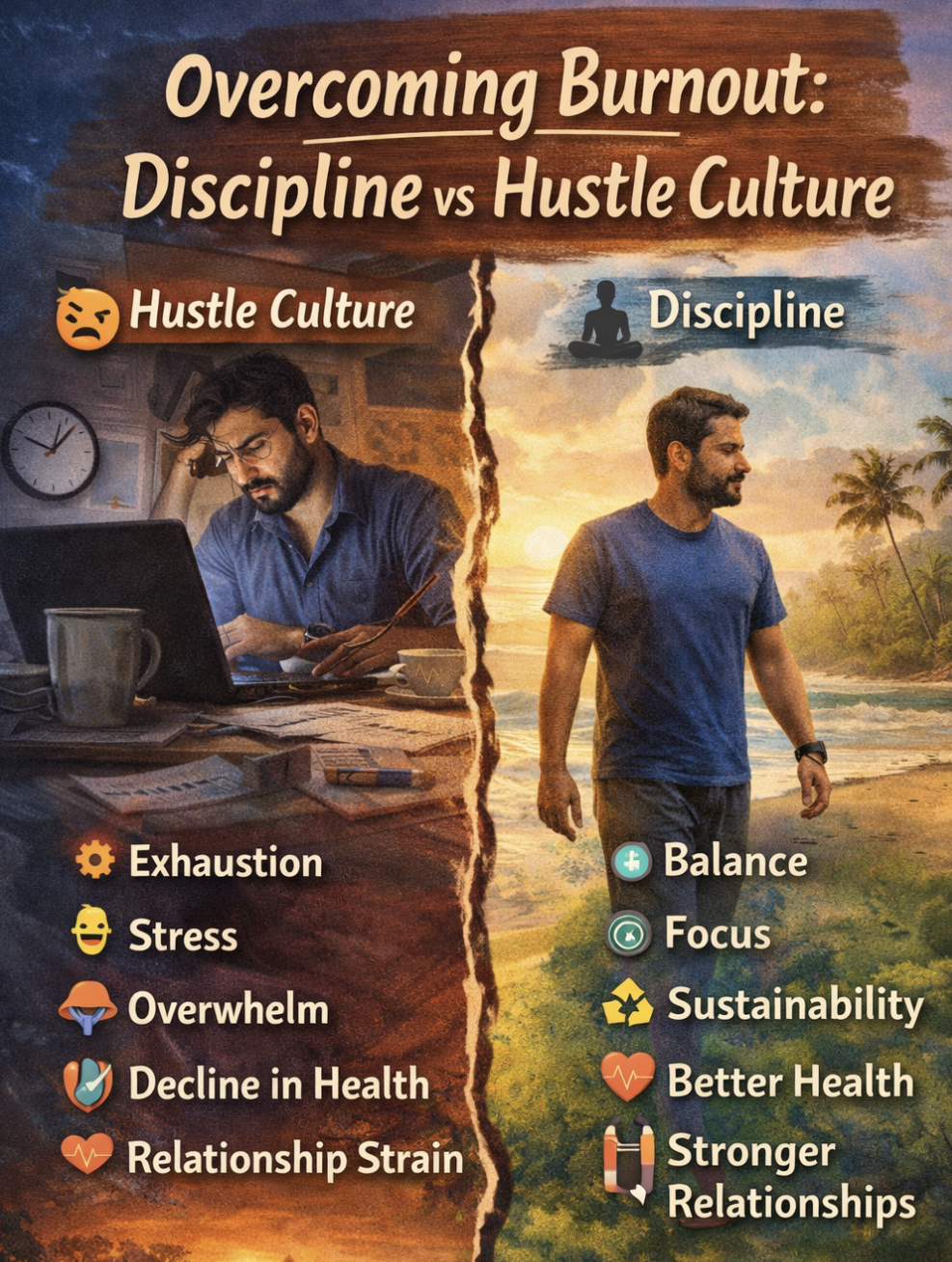
[Image Suggestion: A tired professional looking at a laptop late at night contrasted with a calm sunrise walk near a coastal Karnataka beach]
Understanding Burnout in the Modern Digital World
Burnout is not simply “feeling tired.”
The World Health Organization (WHO) officially recognises burnout as an occupational phenomenon caused by chronic workplace stress that has not been successfully managed.
It often includes:
Physical exhaustion
Mental fatigue
Reduced motivation
Increased negativity
Difficulty concentrating
Emotional detachment
Why Burnout Is Increasing
Today’s work culture makes burnout more common than ever.
Especially in industries like:
Digital marketing
IT
Content creation
Startups
Freelancing
Hospitality
Many professionals are expected to stay constantly available.
Notifications never stop.
Social media never sleeps.
Emails continue even during weekends.
And slowly, people forget how to truly rest.
Coastal Karnataka Taught Me a Different Rhythm
Growing up around Byndoor and Kundapura, life moved differently.
People worked hard, no doubt.
But there was still balance.
Evenings were slower.
Families ate together.
People spent time outdoors.
Nature naturally created pauses.
Today, many young professionals are disconnected from that rhythm.
And I feel that disconnection contributes heavily to stress and burnout.
Hustle Culture Looks Attractive — But Comes at a Cost
Social media often glorifies extreme work culture.
We constantly see messages like:
“Sleep later.”
“Work 18 hours.”
“No days off.”
“Outwork everyone.”
At first glance, it sounds motivating.
But in reality, long-term hustle without recovery damages both health and performance.
What Research Says About Overwork
According to a joint study by the WHO and the International Labour Organization (ILO), working 55 hours or more per week is associated with significantly higher risks of stroke and heart disease.
That’s not motivational.
That’s dangerous.
The Hidden Problems With Hustle Culture
1. It Creates Constant Guilt
People feel guilty while resting.
Even during vacations, many professionals keep checking Slack, WhatsApp, and emails.
2. Productivity Actually Drops
Studies published in journals like Occupational and Environmental Medicine show that chronic stress negatively affects concentration, decision-making, and creativity.
I personally noticed this during periods of intense workload.
I was “working more” but producing lower-quality ideas.
3. Relationships Begin to Suffer
One thing I always remind myself:
No professional achievement feels meaningful if family relationships become weak in the process.
Many people realise this too late.
[Image Suggestion: Split image showing chaotic overwork on one side and peaceful balanced living on the other]
Discipline Is Different From Hustle
This was one of the biggest mindset shifts in my life.
Discipline is not about exhausting yourself.
Discipline is about consistency.
Hustle vs Discipline
Hustle CultureDisciplineDriven by pressureDriven by purposeIgnores restRespects recoveryReactive lifestyleStructured lifestyleConstant urgencyCalm consistencyBurnout-focusedSustainability-focusedSeeks validationBuilds inner stability
Discipline Creates Freedom
Many people think discipline feels restrictive.
Actually, the opposite is true.
When your routines become stable:
Stress reduces
Energy improves
Work becomes smoother
Decision fatigue decreases
For me, simple habits created massive improvements:
Waking up earlier
Limiting late-night work
Planning tasks properly
Exercising regularly
Reducing unnecessary screen time
None of these habits were dramatic.
But together, they changed everything.
How I Started Recovering From Burnout
Recovery didn’t happen overnight.
And honestly, I still have stressful days sometimes.
But certain changes made a huge difference.
1. Prioritising Sleep
For years, I underestimated sleep.
I thought sleeping less meant being more ambitious.
Actually, poor sleep made me emotionally reactive and mentally slower.
According to the Sleep Foundation, most adults need 7–9 hours of sleep for healthy cognitive performance.
Now I protect sleep seriously.
And my productivity is far better because of it.
2. Spending More Time Outdoors
One underrated advantage of living in Karnataka is access to nature.
Whether it’s beaches, greenery, monsoon rain, or quiet temple roads, nature has a calming effect that many people forget about.
Even 20–30 minutes outdoors daily improved my mental clarity.
3. Reducing Digital Noise
I realised my brain was overloaded.
Too much scrolling.
Too many notifications.
Too much comparison.
So I started:
Turning off non-essential notifications
Avoiding social media early in the morning
Taking occasional digital detox breaks
That single change reduced anxiety significantly.
4. Reconnecting With Family
Family conversations have a grounding effect.
Simple meals together.
Evening tea.
Visiting relatives.
Talking without screens nearby.
These small moments matter more than we realise.
Especially during stressful periods.
[Image Suggestion: Family sitting together during evening tea in a traditional Karnataka home]
Why Sustainable Success Matters More
One thing I’ve learned after years in SEO and hotel marketing is this:
Success that destroys your health is not real success.
Many people chase rapid growth but ignore sustainability.
The Long-Term Mindset
In digital marketing, shortcuts often fail eventually.
The same applies to life.
Quick success built on burnout usually becomes unstable.
But disciplined, sustainable effort compounds over time.
What Sustainable Productivity Looks Like
Healthy Productivity Includes:
Regular sleep
Physical movement
Time for family
Deep focus sessions
Real breaks
Mental recovery
Realistic goals
What Burnout Productivity Looks Like
Working while exhausted
Constant multitasking
Emotional frustration
Lack of creativity
Poor health habits
No boundaries
I’ve experienced both.
And sustainable productivity always wins long-term.
Practical Ways to Overcome Burnout
If you currently feel mentally exhausted, overwhelmed, or emotionally drained, here are some practical things that genuinely help.
Start With Small Changes
Burnout recovery does not require dramatic life changes overnight.
Small habits matter more.
Daily Habits That Help
Morning Habits
Avoid checking your phone immediately after waking
Drink enough water
Spend a few minutes outside if possible
Stretch or walk
Work Habits
Use focused work sessions without constant notifications
Take short breaks between tasks
Avoid multitasking excessively
Create realistic schedules
Mental Habits
Stop comparing your life constantly online
Reduce unnecessary information consumption
Practice gratitude
Accept that rest is productive too
Physical Health Matters More Than Most People Think
Many burnout symptoms become worse when:
Sleep is poor
Nutrition is inconsistent
Movement is low
Hydration is ignored
In humid regions like coastal Karnataka, physical fatigue becomes even more noticeable during summer months.
Simple hydration and balanced meals genuinely affect mental energy.
Learn to Say No
This was difficult for me initially.
But saying yes to everything creates emotional overload.
Protecting your time is not selfish.
It’s necessary.
[Image Suggestion: Calm morning routine with tea, notebook, and sunrise near greenery]
The Emotional Side of Burnout Nobody Talks About
Burnout is not only physical.
It can quietly affect:
Confidence
Relationships
Creativity
Emotional stability
Self-worth
Sometimes people feel guilty for slowing down.
But rest is not laziness.
Even nature follows cycles.
Monsoon comes.
Then summer.
Then renewal again.
Human beings also need recovery cycles.
Why Men Often Ignore Burnout
In India especially, many men grow up believing they must always “handle everything silently.”
But emotional exhaustion is real.
Talking to trusted family members, friends, mentors, or professionals can genuinely help.
Mental Peace Is Underrated
Today, many people are chasing income while losing peace.
But peace of mind has real value.
Without mental peace:
Work quality drops
Relationships suffer
Physical health declines
I’ve learned that inner calm improves professional performance far more than panic-driven hustle.
Redefining Success in a Healthier Way
Earlier, I measured success mostly through:
Revenue
Traffic
Rankings
Growth numbers
Now, my definition has evolved.
Today, success also means:
Good health
Stable routines
Time with loved ones
Meaningful work
Mental clarity
Sustainable growth
Ironically, once I stopped obsessing over nonstop hustle, my work quality improved naturally.
What I Tell Younger Professionals
If I could give one honest piece of advice to younger marketers and entrepreneurs, it would be this:
Build a career you can sustain for decades — not just one that looks impressive online for a few years.
Discipline builds long-term strength.
Hustle culture often creates short-term exhaustion.
And there’s a big difference between the two.
Anudeep Hegde
Seasoned Internet Marketing Specialist and Hotel Marketing Expert with over 12+ years of experience helping brands grow and succeed online.
Get in touch
connect@anudeephegde.com
+91 9449507266, +91 9731258717
© 2026. All rights reserved. @Trip Nirvigna Marketing