Paid Ads vs Organic: When to Use What
Discover when to use paid ads vs organic marketing, how to balance both effectively, and build sustainable business growth with smarter digital strategies.
Anudeep Hegde
5/23/20267 min read
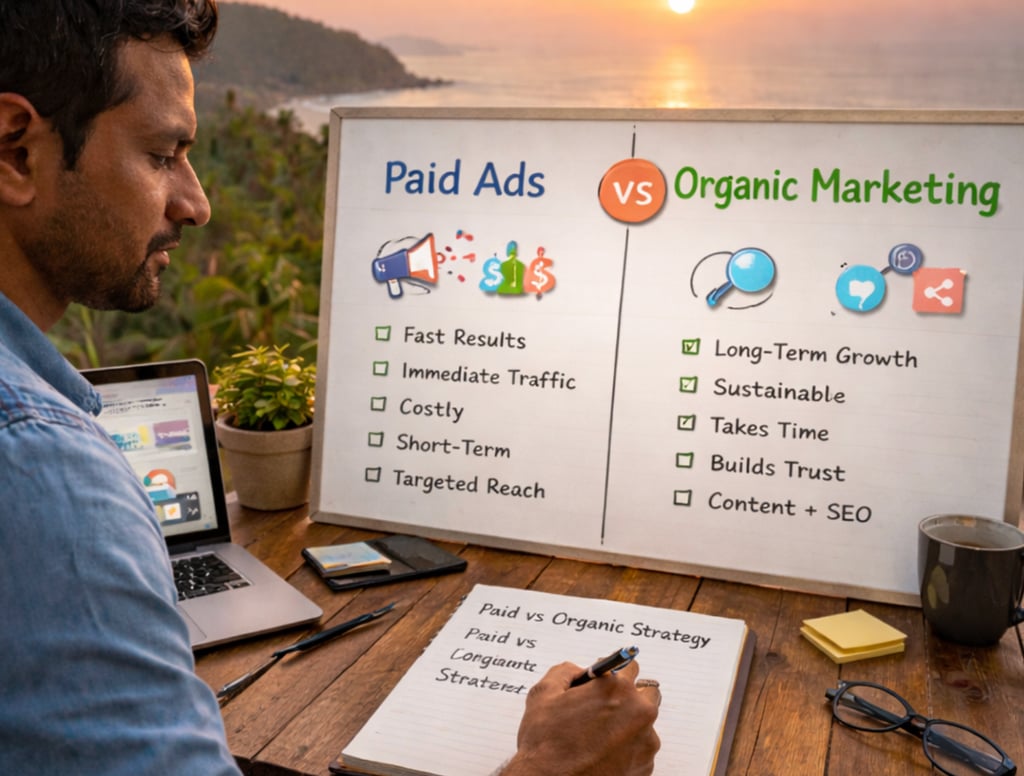
Paid Ads vs Organic: When to Use What
One of the most common questions I hear from business owners, hotel managers, entrepreneurs, and even young marketers is:
"Should we invest in paid ads or focus on organic marketing?"
It's a fair question.
After all, every business has limited resources. Whether it's money, time, manpower, or attention, every investment must justify itself.
Over my 12+ years working in internet marketing and hotel marketing, I've seen businesses succeed with both approaches—and I've also seen businesses waste money because they chose the wrong strategy at the wrong time.
A hotel owner once told me, "We're spending on ads every month, but the moment we stop, inquiries disappear."
On the other hand, I've worked with businesses that relied only on organic content and SEO, only to realise they were growing far slower than necessary in competitive markets.
The truth is simple:
Paid ads and organic marketing are not enemies. They're tools.
The key is knowing when to use each one.
Growing up in Coastal Karnataka taught me something valuable about balance. Fishermen don't depend only on favourable weather. Farmers don't depend only on rainfall. Successful families don't depend on a single source of income.
Likewise, smart marketing rarely depends on a single channel.
The strongest growth often comes from understanding how paid advertising and organic marketing work together.
In this article, I'll share practical insights, real-world examples, and proven frameworks to help you decide when to use paid ads, when to focus on organic growth, and how to build a balanced marketing strategy that supports long-term success.
[Image Suggestion: Split-screen showing digital advertising dashboard on one side and organic content creation workspace on the other]
Understanding Paid Ads and Organic Marketing
Before comparing them, let's define them clearly.
What Are Paid Ads?
Paid advertising involves spending money to promote content, products, services, or offers.
Examples include:
Google Ads
Facebook Ads
Instagram Ads
YouTube Ads
LinkedIn Ads
Display Advertising
Retargeting Campaigns
With paid ads, visibility can happen almost immediately.
Your content reaches targeted audiences because you're paying for distribution.
What Is Organic Marketing?
Organic marketing refers to attracting customers naturally without paying directly for visibility.
Examples include:
Search Engine Optimization (SEO)
Blog content
Social media posts
Email newsletters
YouTube videos
Customer reviews
Word-of-mouth referrals
Organic marketing requires patience but often delivers sustainable long-term benefits.
A Simple Analogy
I often explain it this way:
Paid ads are like renting a house.
You gain immediate access, but payments must continue.
Organic marketing is like building a house.
It takes longer initially, but ownership creates long-term value.
Both have advantages.
The challenge is choosing appropriately.
When Paid Ads Make the Most Sense
There are situations where paid advertising is absolutely the right choice.
1. Launching a New Business
A new business typically has:
Limited visibility
No search rankings
Small social audiences
Minimal brand awareness
Waiting for organic growth alone can take time.
Paid advertising accelerates initial exposure.
2. Promoting Time-Sensitive Campaigns
Examples include:
Seasonal hotel offers
Festival promotions
Limited-time discounts
Event registrations
New product launches
If results are needed quickly, paid ads can generate immediate traffic.
3. Testing New Markets
One major advantage of advertising is speed.
Businesses can quickly test:
Audience segments
Locations
Messaging
Creative concepts
Pricing offers
Instead of waiting months, insights can emerge within days or weeks.
4. Retargeting Interested Customers
Research consistently shows that consumers often require multiple interactions before making purchasing decisions.
Retargeting allows businesses to reconnect with visitors who previously showed interest.
For example:
Website visitors
Cart abandoners
Inquiry form starters
Previous customers
These campaigns often produce strong results because audience intent already exists.
Key Benefits of Paid Advertising
✔ Fast visibility
✔ Precise targeting
✔ Predictable traffic
✔ Rapid testing opportunities
✔ Scalable campaigns
Potential Drawbacks
✘ Costs increase over time
✘ Traffic stops when budgets stop
✘ Competitive industries can become expensive
✘ Requires ongoing optimisation
[Image Suggestion: Marketer managing paid advertising campaigns with performance dashboards and conversion reports]
When Organic Marketing Is the Better Choice
Organic marketing requires patience but creates powerful long-term advantages.
1. Building Long-Term Authority
People trust businesses that consistently demonstrate expertise.
Examples include:
Helpful articles
Educational videos
Industry insights
Case studies
Local knowledge
Organic content establishes credibility over time.
2. Improving Search Visibility
According to Google's Search documentation, helpful, experience-based content supports long-term search visibility when combined with technical SEO best practices.
For businesses, strong organic rankings can generate traffic for years.
3. Building Community and Trust
One thing I've noticed repeatedly across Karnataka businesses is the importance of relationships.
Customers often choose businesses they trust.
Organic content helps build that trust through:
Consistent communication
Helpful information
Authentic storytelling
Audience engagement
4. Reducing Dependence on Advertising
Businesses relying exclusively on ads face constant spending pressure.
Organic channels create marketing assets that continue generating value.
Examples:
Blog articles
SEO rankings
Email lists
YouTube content
Brand reputation
Key Benefits of Organic Marketing
✔ Sustainable growth
✔ Stronger trust
✔ Long-term traffic
✔ Lower acquisition costs over time
✔ Brand authority development
Potential Drawbacks
✘ Slower results
✘ Requires consistency
✘ Competitive keywords take time
✘ Results may not be immediate
[Image Suggestion: Content creator writing SEO-focused articles while reviewing website analytics]
Comparing Paid Ads and Organic Marketing
The best way to understand the difference is through direct comparison.
FactorPaid AdsOrganic MarketingSpeedImmediateGradualCost StructureOngoing spendTime and effort investmentTraffic ControlHighModerateLong-Term ValueLimited after spending stopsCompounds over timeBrand TrustModerateStrongScalabilityFastSteadySustainabilityLowerHigherTesting AbilityExcellentSlower
Which One Generates Better ROI?
The answer depends on objectives.
For immediate results:
Paid ads often win.
For long-term growth:
Organic marketing usually provides stronger cumulative value.
The smartest businesses combine both.
Why the Best Marketing Strategies Use Both
One of the biggest mistakes businesses make is treating this as an either-or decision.
In reality, paid and organic channels complement each other.
Organic Creates Trust
Organic content helps audiences:
Discover expertise
Learn from your experience
Understand your values
Build confidence
Paid Ads Create Reach
Advertising helps:
Accelerate exposure
Expand audience reach
Generate leads quickly
Promote important campaigns
Together They Become Powerful
Consider this example:
A hotel publishes:
Travel guides
Local attraction articles
Festival recommendations
Coastal Karnataka itineraries
These organic assets attract visitors through search engines.
Meanwhile, paid campaigns promote:
Seasonal packages
Holiday offers
Special experiences
The two channels reinforce each other.
A Practical Marketing Funnel
Top of Funnel
Organic:
Blog posts
Social media content
Videos
Middle of Funnel
Paid:
Retargeting campaigns
Lead generation ads
Bottom of Funnel
Paid + Organic:
Reviews
Testimonials
Booking offers
Conversion-focused landing pages
This balanced approach improves efficiency.
[Image Suggestion: Marketing funnel diagram showing organic content feeding paid conversion campaigns]
Common Mistakes Businesses Make
Over the years, I've observed several recurring mistakes.
Avoiding them can save significant time and money.
Mistake 1: Expecting Instant SEO Results
SEO is powerful.
But it takes time.
Businesses that abandon organic efforts after a few months often miss substantial future opportunities.
Mistake 2: Depending Entirely on Paid Ads
Advertising works well.
But complete dependence creates vulnerability.
Budget interruptions often lead to traffic declines.
Mistake 3: Ignoring Content Quality
Whether paid or organic, poor content performs poorly.
Helpful, relevant, audience-focused content remains essential.
Mistake 4: Measuring Vanity Metrics
Followers and impressions matter less than:
Leads
Sales
Bookings
Conversions
Customer retention
Focus on business outcomes.
Mistake 5: Not Tracking Results
Always measure:
Conversion rates
Traffic sources
Revenue contribution
Customer acquisition costs
Without measurement, optimisation becomes impossible.
Choosing the Right Strategy for Your Business
Every business situation differs.
Here's a practical guide.
Choose Paid Ads If You Need:
Immediate visibility
Fast lead generation
Product launch support
Event promotion
Rapid market testing
Choose Organic Marketing If You Want:
Long-term growth
Brand authority
Search visibility
Customer trust
Sustainable traffic
Choose Both If You Want:
Balanced growth
Better risk management
Higher overall visibility
Stronger marketing resilience
For most businesses, this is the ideal approach.
A Simple Budget Framework
While exact allocations vary, many growing businesses benefit from:
Investing in content and SEO consistently
Using paid campaigns strategically
Retargeting engaged audiences
Measuring performance regularly
Balance matters more than perfection.
[Image Suggestion: Small business owner evaluating both SEO reports and advertising campaign results]
Lessons From Coastal Karnataka About Sustainable Growth
Living in Coastal Karnataka offers constant reminders about patience and sustainability.
The monsoon doesn't arrive overnight.
Coconut trees don't grow in a few weeks.
Relationships within families and communities develop over years.
Meaningful growth follows similar principles.
Marketing often works best when businesses combine:
Patience with action
Strategy with execution
Long-term thinking with short-term opportunities
Paid advertising provides acceleration.
Organic marketing provides foundations.
Neither replaces the other.
Think Like a Long-Term Builder
Whenever evaluating marketing investments, ask:
Will this create immediate results?
Will this create lasting value?
How can both objectives work together?
Those questions often lead to smarter decisions.
The Future of Digital Marketing
As digital platforms continue evolving, one trend remains consistent:
Consumers increasingly value trust, relevance, and authenticity.
According to Edelman's Trust Barometer studies, trust remains a major influence on consumer decisions across industries.
This means:
Paid ads may attract attention.
Organic marketing often earns confidence.
Businesses that combine visibility with trust will likely continue outperforming those focused exclusively on one channel.
The future belongs to marketers who understand both.
[Image Suggestion: Coastal Karnataka sunrise symbolising balanced long-term business growth and strategic marketing]
Conclusion
Paid ads vs organic marketing is not a battle with a single winner.
Each serves a different purpose.
Paid advertising delivers speed, reach, and immediate opportunities.
Organic marketing builds trust, authority, and sustainable growth.
Over my years in internet marketing and hotel marketing, I've seen businesses achieve remarkable results when they stop viewing these channels as competitors and start using them strategically together.
The most successful marketing systems often follow a simple formula:
Use paid ads to accelerate visibility.
Use organic marketing to build credibility.
Measure results carefully.
Continuously improve both.
Whether you're running a hotel, restaurant, tourism business, startup, or personal brand, the goal isn't choosing sides.
The goal is choosing the right tool at the right time.
Build patiently.
Invest wisely.
Stay consistent.
And remember that sustainable growth usually comes from balancing short-term opportunities with long-term foundations.
FAQs
1. What is the difference between paid ads and organic marketing?
Paid ads involve paying for visibility through platforms like Google or Meta, while organic marketing attracts audiences naturally through content, SEO, social engagement, and brand building.
2. Which is better: paid ads or organic marketing?
Neither is universally better. Paid ads provide faster results, while organic marketing creates stronger long-term value and sustainable growth.
3. How long does organic marketing take to show results?
SEO and content marketing often require several months before significant results appear, depending on competition, content quality, and website authority.
4. Are paid ads necessary for small businesses?
Not always. However, paid ads can help accelerate visibility, generate leads quickly, and support important campaigns when used strategically.
5. Can SEO replace paid advertising?
SEO can generate substantial traffic over time, but paid advertising remains useful for promotions, launches, testing, and immediate visibility.
6. How much should a business invest in paid advertising?
Budgets vary based on goals, industry competition, and business size. The most important factor is tracking ROI rather than focusing solely on spending levels.
7. What metrics should businesses track?
Key metrics include conversions, leads, bookings, revenue, customer acquisition cost, return on ad spend, organic traffic, and engagement quality.
8. Is it possible to combine paid ads and organic marketing effectively?
Yes. In fact, combining both approaches often creates the strongest results by balancing immediate reach with long-term authority and trust.
.
Click Here To Know about How Self-Improvement Made Me a Better SEO Consultant
Anudeep Hegde
Seasoned Internet Marketing Specialist and Hotel Marketing Expert with over 12+ years of experience helping brands grow and succeed online.
Get in touch
connect@anudeephegde.com
+91 9449507266, +91 9731258717
© 2026. All rights reserved. @Trip Nirvigna Marketing