Time Management Hacks for Busy Indian Entrepreneurs
Discover practical time management hacks for busy Indian entrepreneurs to improve focus, productivity, balance, and long-term success.
anudeep hegde
5/14/20266 min read
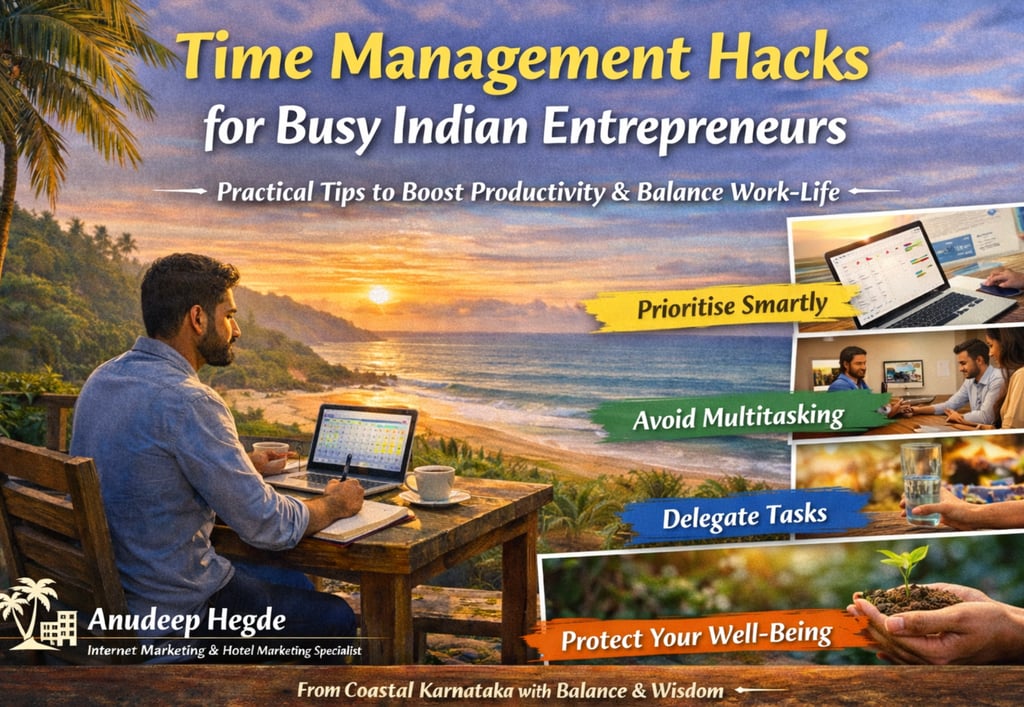
Time Management Hacks for Busy Indian Entrepreneurs
One thing I’ve realised after spending more than 12 years in digital marketing and hotel marketing is this:
Most entrepreneurs are not lazy. They are simply overwhelmed.
Between client calls, staff management, social media, payments, family responsibilities, marketing, and unexpected daily problems, many business owners feel like there are never enough hours in the day.
I’ve experienced this personally too.
There were phases in my career when my mind constantly felt “switched on.” Even during family dinners or evening walks near the beach in Byndoor, I would still be thinking about campaigns, pending work, or client deadlines.
Over time, I understood something important:
Good time management is not about squeezing more work into the day. It’s about creating clarity, focus, and balance.
Especially in India, entrepreneurship comes with unique challenges:
Family responsibilities
Unpredictable work environments
Staff coordination
Traffic and travel
Constant phone calls
Financial pressure
Social expectations
That’s why generic “productivity advice” from Western corporate culture doesn’t always fit our realities.
In this article, I want to share practical time management hacks for busy Indian entrepreneurs that genuinely helped me improve focus, reduce stress, and work more meaningfully — without feeling mentally exhausted all the time.
These are simple, practical habits shaped by real business experience, local lifestyle observations, and years of learning through both mistakes and growth.
[Image Suggestion: Entrepreneur planning work calmly during sunrise in coastal Karnataka]
Why Time Management Matters More Than Ever Today
Modern business moves fast.
Customers expect quick replies.
Social media never stops.
Marketing trends change rapidly.
And smartphones keep us connected 24/7.
The result?
Many entrepreneurs stay busy all day but still feel unproductive.
The Problem Is Not Always Lack of Time
In many cases, the real problems are:
Constant distractions
Poor planning
Mental overload
Lack of prioritisation
Digital addiction
According to a report by Asana’s Anatomy of Work Index, workers spend a significant amount of time managing communication and coordination rather than deep, focused work.
I’ve noticed this personally in marketing.
Some days can disappear entirely into:
WhatsApp messages
Calls
Emails
Meetings
Social media notifications
By evening, the mind feels tired, but meaningful progress feels small.
Time Is Emotional Energy Too
One thing I strongly believe:
Time management is actually energy management.
If your brain feels exhausted:
Creativity drops
Decision-making becomes emotional
Patience reduces
Productivity suffers
That’s why sustainable routines matter more than extreme hustle.
Start the Day Before the World Becomes Noisy
One of the biggest improvements in my productivity came from protecting my mornings.
Earlier, like many entrepreneurs, I used to begin the day by checking:
WhatsApp
Emails
Instagram
Client messages
News
Within minutes, my brain felt stressed.
What Changed My Routine
Now, I try to create at least 30–45 minutes of calm before digital noise begins.
My Preferred Morning Routine
Wake up early
Drink water immediately
Spend a few minutes quietly
Avoid social media initially
Plan key priorities for the day
Living in coastal Karnataka helps here. Early mornings near Byndoor feel peaceful before the humidity and traffic increase later in the day.
Morning Light Improves Alertness
According to a 2023 study published in Frontiers in Psychology, exposure to natural morning light supports mood, alertness, and healthy circadian rhythm.
Even stepping outside briefly can refresh the mind.
Simple Morning Time Management Hacks
Write Only 3 Major Priorities
Too many tasks create mental confusion.
Avoid Reactive Mornings
Do not start the day solving everyone else’s problems immediately.
Keep Phone Notifications Limited
Not every message deserves instant attention.
A calm morning often creates a productive day.
[Image Suggestion: Peaceful morning workspace with notebook, tea, and coastal sunlight]
Deep Work Is More Powerful Than Multitasking
Many entrepreneurs believe multitasking improves productivity.
In reality, constant task-switching often reduces focus.
I learned this the hard way.
Earlier, I would:
Attend calls
Reply to WhatsApp
Check SEO reports
Write content
Monitor ads
…all at the same time.
By evening, my mind felt exhausted.
What Is Deep Work?
Deep work means focusing fully on one important task without distractions.
Author Cal Newport popularised this concept, but honestly, focused work has always existed naturally in traditional lifestyles too.
How I Organise Work Blocks
TimeFocus AreaMorningCreative work, SEO, writingMiddayMeetings and communicationAfternoonReports and optimisationEveningLight admin tasks
This structure reduced mental clutter significantly.
Benefits of Deep Work
Better creativity
Faster completion
Fewer mistakes
Lower stress
Better decision-making
Practical Focus Hacks
Turn Off Notifications During Important Work
Even 45 minutes of uninterrupted focus helps.
Batch Similar Tasks Together
Avoid switching constantly between creative and analytical tasks.
Schedule Social Media Usage
Scrolling throughout the day silently destroys concentration.
According to research from the University of California Irvine, interruptions can significantly delay the return to focused work.
That explains why many entrepreneurs feel mentally scattered.
Learn the Difference Between Urgent and Important
This is one of the biggest lessons entrepreneurship taught me.
Not every urgent-looking task is truly important.
Many entrepreneurs spend entire days solving small problems while ignoring bigger priorities.
The Trap of Constant Urgency
Examples include:
Endless phone calls
Non-stop notifications
Last-minute requests
Small operational issues
These tasks consume time but may not create long-term growth.
Important Work Usually Feels Quiet
Real business growth often comes from:
Planning
Strategy
Building systems
Learning
Relationship-building
Unfortunately, these tasks rarely feel “urgent.”
A Simple Prioritisation Method
I often ask myself:
Does this task truly matter long-term?
Can this wait?
Can someone else handle this?
Is this helping growth or only reducing temporary stress?
This mindset reduced unnecessary pressure significantly.
Protect Time for Strategic Thinking
Many entrepreneurs never pause to think deeply because daily operations consume all mental energy.
Even 20–30 minutes of quiet planning daily helps.
Sometimes my best ideas come during:
Early morning walks
Drives near the coast
Quiet evenings during monsoon season
Mental space matters.
[Image Suggestion: Entrepreneur thinking quietly beside a coastal road during sunset]
Your Health Directly Affects Time Management
This is something many entrepreneurs ignore until burnout happens.
Poor health silently destroys productivity.
Signs Your Body Is Overloaded
Constant fatigue
Brain fog
Poor concentration
Irritability
Sleep problems
In coastal Karnataka, weather itself affects energy.
High humidity and heat can increase tiredness and dehydration quickly.
Hydration Matters More Than People Think
According to the Centers for Disease Control and Prevention (CDC), dehydration affects mood, memory, and concentration.
Simple habits help:
Drinking water regularly
Tender coconut water
Buttermilk during summer
Taking short movement breaks
Sleep Is a Productivity Tool
Many entrepreneurs proudly say:
“I only sleep 4–5 hours.”
But poor sleep reduces:
Creativity
Emotional balance
Decision quality
According to the Sleep Foundation, adults generally require 7–9 hours of sleep for proper cognitive functioning.
Small Health Habits Improve Productivity
Eat Lighter During Work Hours
Heavy meals often reduce focus.
Move Daily
Walking improves mental clarity surprisingly well.
Reduce Late-Night Screen Exposure
This improves sleep quality.
Entrepreneurship is a marathon, not a sprint.
Delegate More and Control Less
One mistake many Indian entrepreneurs make is trying to handle everything personally.
I understand why.
Many business owners feel:
“Only I can do this properly.”
“Staff may make mistakes.”
“I need to monitor everything.”
But over-controlling creates exhaustion.
Delegation Is Not Weakness
It is necessary for growth.
Tasks Entrepreneurs Should Gradually Delegate
Basic admin work
Routine follow-ups
Simple design tasks
Scheduling
Data entry
Repetitive communication
Focus on High-Value Work
Your energy should go toward:
Strategy
Leadership
Decision-making
Relationship-building
Innovation
Systems Reduce Stress
Simple systems help:
Shared calendars
Task management tools
SOPs (standard operating procedures)
Automated reminders
You don’t need complicated software initially.
Even simple organisation creates huge mental relief.
[Image Suggestion: Entrepreneur collaborating calmly with team members in office]
Family Balance and Mental Peace Improve Productivity
One thing I deeply appreciate about Indian culture — especially in coastal Karnataka — is the importance of family connection.
Modern entrepreneurship often glorifies nonstop work.
But honestly, success feels incomplete without peace of mind.
Emotional Stability Improves Work Quality
When life outside work feels balanced:
Thinking becomes clearer
Stress reduces
Creativity improves
Patience increases
Simple Personal Habits That Helped Me
Eating meals with family
Keeping partial phone-free time
Taking evening walks
Spending time in nature
Reducing unnecessary online arguments
Nature Quietly Resets the Mind
Living near the coast constantly reminds me to slow down occasionally.
Some clarity comes not from productivity apps but from:
Watching rain
Sitting near the sea
Listening to silence
Spending time offline
Burnout Is Becoming Common
According to the World Health Organization (WHO), chronic stress can negatively impact physical and mental health.
Entrepreneurs often ignore emotional exhaustion because work pressure feels “normal.”
But protecting mental peace is also part of time management.
Sustainable Time Management Is Better Than Hustle Culture
Social media often promotes unrealistic lifestyles.
Wake up at 4 AM.
Work 18 hours.
Never rest.
Always hustle.
But long-term productivity rarely works like that.
Sustainable Productivity Looks Different
It focuses on:
Consistency
Health
Balance
Strategic thinking
Long-term growth
Build Routines, Not Extreme Schedules
Small habits matter more than temporary motivation.
A Simple Sustainable Routine
Morning
Quiet planning
Hydration
Focus work
Afternoon
Meetings
Coordination
Operational tasks
Evening
Family time
Reflection
Rest
Progress Comes From Consistency
In my experience, businesses grow stronger through steady improvement, not constant chaos.
[Image Suggestion: Calm evening family moment after work in coastal Karnataka]
Conclusion
Time management hacks for busy Indian entrepreneurs are not about becoming robotic or working nonstop. Real productivity comes from clarity, focus, health, and balance.
Over the years, I’ve realised that entrepreneurship becomes much more sustainable when we stop glorifying exhaustion and start respecting our mental and physical energy.
Simple habits create powerful results:
Protecting mornings
Reducing distractions
Prioritising deeply
Delegating wisely
Taking care of health
Spending time with family
Living in coastal Karnataka has constantly reminded me that life moves in rhythms, not constant urgency. Nature works steadily, patiently, and consistently — and maybe business growth should feel the same way too.
Success is important. But peace of mind matters too.
And honestly, the best entrepreneurs are often not the busiest people — they are the ones who manage their energy, attention, and priorities wisely.
.
for more information click here
Anudeep Hegde
Seasoned Internet Marketing Specialist and Hotel Marketing Expert with over 12+ years of experience helping brands grow and succeed online.
Get in touch
connect@anudeephegde.com
+91 9449507266, +91 9731258717
© 2026. All rights reserved. @Trip Nirvigna Marketing