Content Clusters for Topical Authority
Learn how content clusters build topical authority, improve rankings, and drive sustainable organic traffic with a practical SEO framework.Blog post description.
Anudeep Hegde
6/8/20266 min read
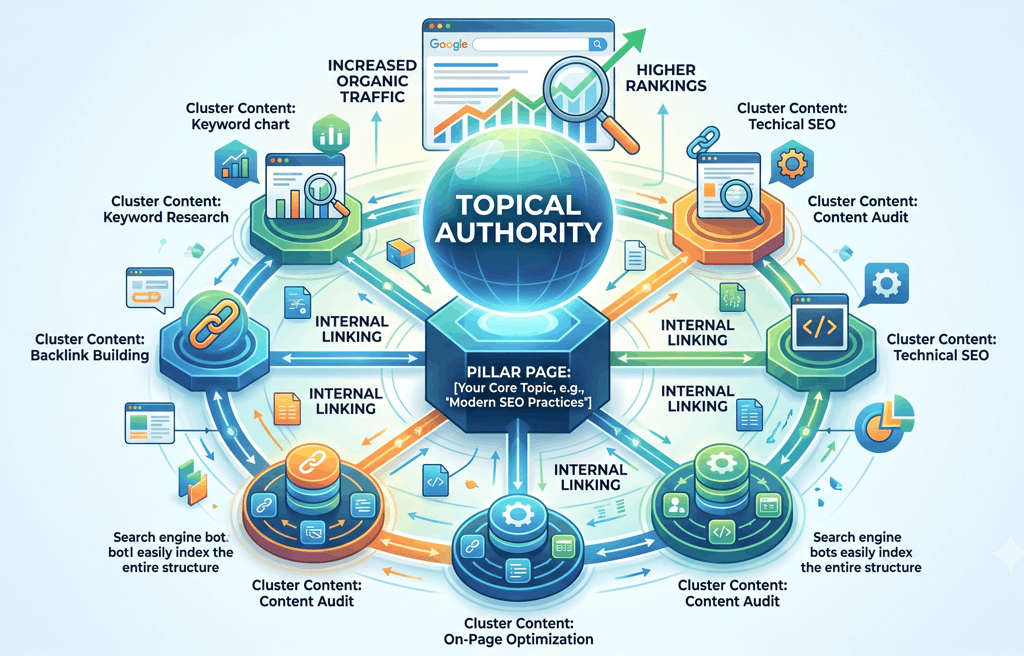
Content Clusters for Topical Authority: The SEO Strategy That Still Works
A few years ago, ranking a website on Google often felt like a game of keywords. Find a keyword, write an article, build a few links, and hope for the best.
Today, things are very different.
Google has become significantly better at understanding topics, relationships between concepts, and the overall expertise demonstrated by a website. In simple terms, publishing random articles is no longer enough. If you want sustainable organic visibility, you need to show Google that you genuinely know a subject inside and out.
This is where Content Clusters for Topical Authority come into the picture.
Over the last decade working with hotels, tourism businesses, local brands, and service-based companies, I have seen one pattern repeat itself: websites that organize content around topics consistently outperform websites that publish disconnected blog posts.
Whether you're running a hotel in Udupi, a travel company in Mangalore, an eCommerce store, or a personal brand, content clusters can transform your SEO results.
In this guide, I'll explain what content clusters are, why they matter, and how to build them effectively in 2025 and beyond.
What Are Content Clusters?
A content cluster is a group of related content pieces organized around a central topic.
Think of it like a coconut tree.
The trunk represents the main topic, while the branches represent related subtopics. Together, they create a complete ecosystem.
Instead of publishing isolated articles, you build a network of interconnected content.
A Simple Example
Let's say you own a hotel website.
Your main topic could be:
"Hotel Digital Marketing"
Supporting content could include:
Hotel SEO
Hotel Google Business Profile Optimization
Hotel Social Media Marketing
Hotel Website Design
Hotel Email Marketing
Online Reputation Management
Hotel Booking Engine Optimization
Local SEO for Hotels
Each article links back to the main pillar page and to other relevant supporting articles.
This creates a strong topical structure that helps both users and search engines.
The goal is simple: become the most helpful resource on a subject.
Why Google Rewards Topical Authority
Google's mission has always been to provide the best answer to users.
When your website covers an entire topic comprehensively, Google gains confidence in your expertise.
According to Google's Search Quality Evaluator Guidelines, concepts like Experience, Expertise, Authoritativeness, and Trustworthiness (E-E-A-T) play an important role in evaluating content quality.
Topical authority supports these signals naturally.
Why It Works
When your website covers a topic deeply:
Users stay longer
Internal linking improves navigation
Search engines understand context better
More long-tail keywords rank naturally
Trust increases
Imagine two websites.
Website A has one article about hotel SEO.
Website B has 30 interconnected articles covering every aspect of hotel SEO.
Which website would Google consider more authoritative?
The answer is obvious.
Real-World Observation
I often compare this to traditional knowledge in Coastal Karnataka.
If you want advice on farming coconuts, people trust the farmer who has spent decades understanding soil, rainfall, pests, irrigation, and harvesting—not someone who read one article last week.
Google works similarly.
Depth creates trust.
The Core Structure of a Content Cluster
Every content cluster typically contains three components.
1. Pillar Page
The pillar page is the primary resource.
It broadly covers the topic while linking to detailed supporting content.
Example:
Hotel Marketing Guide
The pillar page provides an overview of:
SEO
Social media
Content marketing
Reviews
Advertising
Conversion optimization
But it doesn't go too deep.
Instead, it links to detailed cluster articles.
2. Cluster Content
These are detailed articles focused on specific subtopics.
Examples:
How Hotels Can Improve Google Rankings
Hotel SEO Checklist
Local SEO for Resorts
Hotel Website Speed Optimization
Each article explores one topic comprehensively.
3. Internal Linking
This is the glue holding everything together.
Links should connect:
Cluster pages to pillar pages
Pillar pages to cluster pages
Related cluster pages to each other
This helps users and search engines understand relationships.
How to Build Content Clusters Step by Step
Many businesses overcomplicate content strategy.
In reality, the process can be surprisingly straightforward.
Step 1: Choose One Core Topic
Start with a topic directly connected to your business.
Examples:
Business TypeCore TopicHotelHotel MarketingTravel AgencyTravel PlanningDentistDental CareReal EstateProperty InvestmentPersonal BrandDigital Marketing
Choose a topic you can realistically own.
Step 2: Identify Subtopics
Ask:
What questions do customers ask?
What services do we provide?
What problems do people face?
For hotel marketing, subtopics might include:
SEO
Content marketing
Social media
Reputation management
Google Ads
Booking optimization
Step 3: Map Search Intent
Not every searcher wants the same thing.
Some want information.
Others want solutions.
Others want to buy.
Create content for different stages:
Awareness
What is hotel SEO?
Consideration
Hotel SEO vs Google Ads
Decision
Best hotel marketing agency
Step 4: Publish Consistently
One of the biggest mistakes I see is inconsistency.
Businesses publish five articles in January and disappear for six months.
Topical authority is built through consistency.
Even publishing two quality articles per month can create tremendous momentum over time.
Step 5: Update Existing Content
Google values freshness when it improves usefulness.
Review content regularly:
Update statistics
Add new examples
Improve internal links
Refresh screenshots
Expand sections
Think of content as a garden.
It requires ongoing care.
[Image Suggestion: A visual diagram showing a central pillar page connected to multiple cluster articles.]
Common Mistakes That Destroy Topical Authority
I've audited many websites over the years, and the same issues appear repeatedly.
Publishing Random Content
A hotel blog suddenly publishing articles about cryptocurrency, celebrity gossip, and fashion trends sends confusing signals.
Stay focused.
Ignoring Internal Links
Without internal links, content becomes isolated.
Search engines struggle to understand relationships.
Chasing Only High-Volume Keywords
Many low-volume keywords convert extremely well.
Sometimes a keyword with 100 monthly searches can generate more revenue than one with 10,000 searches.
Thin Content
A 300-word article rarely demonstrates expertise.
Focus on solving problems thoroughly.
Copying Competitors
Your experiences, insights, and perspective are unique.
Use them.
Originality matters.
Content Clusters and AI Search: Why They Matter More Than Ever
The rise of AI-powered search experiences is changing how information is discovered.
Search engines increasingly evaluate whether a source demonstrates broad expertise across an entire topic.
This makes content clusters even more valuable.
What AI Systems Prefer
AI systems tend to trust sources that show:
Consistency
Depth
Accuracy
Comprehensive coverage
Clear topic relationships
A well-built content cluster naturally provides all of these signals.
Future-Proofing Your Website
SEO tactics come and go.
I've seen algorithm updates transform the industry countless times.
Yet one principle remains constant:
The websites that genuinely help users tend to win over the long term.
Content clusters align perfectly with this principle.
Lessons from Coastal Karnataka: Why Ecosystems Always Win
Growing up around Coastal Karnataka, I have always admired how nature works.
Whether it's a coconut grove, a paddy field, or the Western Ghats ecosystem, everything is interconnected.
Nothing exists in isolation.
Content works the same way.
One article alone rarely creates authority.
A connected ecosystem of helpful content does.
Just as healthy soil supports strong trees, strong internal content structures support long-term SEO growth.
This perspective has influenced how I approach digital marketing projects even today.
When we focus on building ecosystems instead of individual pages, the results tend to be more sustainable.
[Image Suggestion: Coconut grove in Coastal Karnataka symbolizing interconnected growth and sustainability.]
Measuring the Success of Content Clusters
How do you know your strategy is working?
Track these metrics:
Organic Traffic Growth
Monitor traffic to:
Pillar pages
Cluster pages
Entire topic categories
Keyword Visibility
Track:
Primary keywords
Long-tail keywords
Informational searches
User Engagement
Watch:
Average engagement time
Pages per session
Scroll depth
Conversions
The ultimate goal isn't traffic.
It's business growth.
Measure:
Leads
Bookings
Calls
Enquiries
Sales
Sometimes the most valuable content isn't the most visited content.
It's the content that builds trust.
The Long-Term Advantage of Content Clusters for Topical Authority
Content clusters are not a shortcut.
They're a long-term investment.
But that's precisely why they work.
Instead of chasing algorithm loopholes, you're building something genuinely useful.
A website that answers dozens—or even hundreds—of questions within a topic becomes difficult to ignore.
Over time, you earn:
Higher rankings
Better trust
Stronger brand recognition
More qualified traffic
Sustainable growth
And perhaps most importantly, you create resources that genuinely help people.
In a world increasingly flooded with content, usefulness remains a competitive advantage.
Conclusion
Content Clusters for Topical Authority are not just another SEO trend. They represent a smarter, more sustainable way of building online visibility.
From my experience in digital marketing and hotel marketing, the businesses that win online are rarely the ones chasing shortcuts. They are the ones consistently educating, helping, and serving their audience.
Whether you're running a hotel, a local business, an eCommerce store, or a personal brand, start by choosing one topic you want to own. Build a pillar page, create supporting content, connect everything intelligently, and keep improving over time.
Just like nurturing a coconut tree in Coastal Karnataka, authority doesn't grow overnight. But with patience, consistency, and care, the results can last for years.
The best time to build topical authority was yesterday. The second-best time is today.
FAQs
1. What is a content cluster in SEO?
A content cluster is a group of interconnected articles centered around a primary topic, helping search engines understand your expertise and improving topical authority.
2. What is topical authority?
Topical authority is the level of expertise and trust a website demonstrates on a specific subject through comprehensive content coverage.
3. How many articles should a content cluster have?
There is no fixed number. Many successful clusters start with 8–15 supporting articles and expand over time.
4. Do content clusters improve Google rankings?
Yes. Properly structured content clusters help search engines understand topic relationships and often improve visibility across related keywords.
5. What is a pillar page?
A pillar page is the main resource covering a broad topic and linking to detailed supporting articles within the cluster.
6. Are content clusters still relevant in 2025?
Absolutely. As search engines and AI systems become more sophisticated, comprehensive topic coverage is becoming even more important.
7. How often should I update content clusters?
Review important content every 6–12 months and update whenever new information, trends, or opportunities emerge.
8. Can small businesses use content clusters?
Yes. In fact, content clusters are one of the most effective ways for small businesses to compete with larger brands in organic search.
.
click here to know about Building Habits That Stick Through Marketing Lessons
Anudeep Hegde
Seasoned Internet Marketing Specialist and Hotel Marketing Expert with over 14+ years of experience helping brands grow and succeed online.
Get in touch
connect@anudeephegde.com
Bangalore & Kundapura, India
© 2026. All rights reserved. @Trip Nirvigna Marketing
+91 9449507266, +91 9731258717